
When paid social performance declines, most brands point to rising CPMs. In many cases, though, the issue actually starts earlier, before an ad ever enters the auction, and can often be caused by a lack of creative diversity.
Social media platforms like Meta and TikTok use AI to assess and match creative content to individuals, predicting what each person is most likely to engage with. As a result, the creative aspect of advertisements plays a much larger role in determining who sees your ad than many teams realize. In fact, creative content is the most crucial factor in a campaign’s success, with Meta reporting that it accounts for 56% of all outcomes.
As Alex Namatevs, Blue Wheel’s Client Services Director of Performance Media/DTC, put it, “If you have all the same creative, it limits the audiences you get in front of, because creatives are your targeting.”
And once you start looking at performance through that lens, things start to shift. Budget and audience structure still matter, but results increasingly come down to whether your creative gives the platform enough variation to actually learn, match, and scale.
The Problem: Sameness at Scale
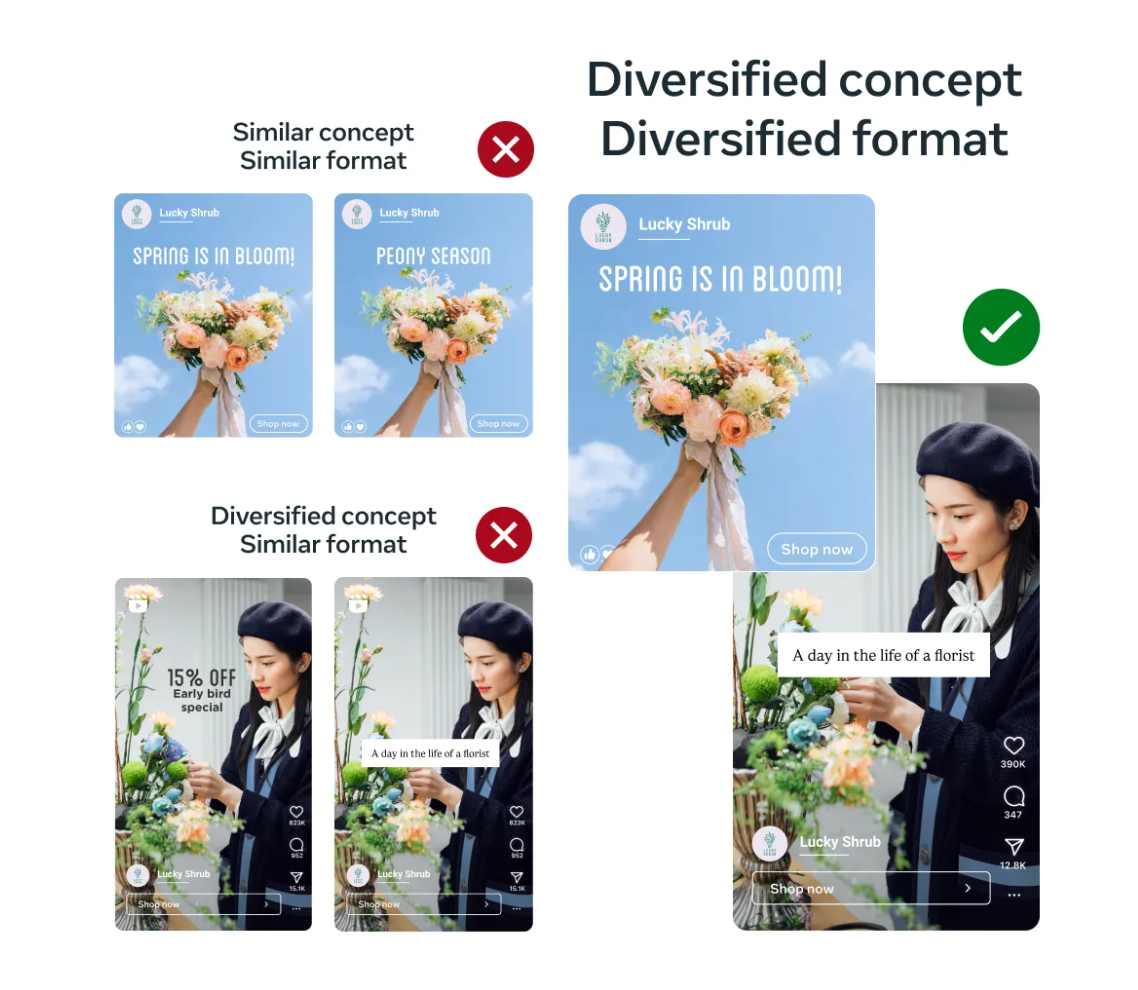
Most brands would say they’re testing creative. But when you take a closer look, it’s usually the same idea showing up in slightly different ways. The message changes a bit, the visuals get tweaked, maybe the format shifts, but the core concept stays the same.
And while it can feel like variety from your brand’s side, platforms tend to read it as repetition. Their systems are designed to pick up on those similarities. When ads are too close to each other, they often get grouped together and end up competing in the same auction. Instead of expanding reach, they compete for the same opportunities.
That’s where things start to break down. Reach gets harder to grow, performance becomes less consistent, and creative fatigue shows up faster than expected. It doesn’t always look like a creative issue at first, but it often ties back to one.
Why Creative Diversity Matters Now
The biggest shift in paid social is how platforms decide what gets shown in the first place. Instead of starting with audiences, Meta and TikTok now start with creative. They evaluate large pools of ads and select the ones most likely to resonate with each user.
That decision happens early, before bidding, before delivery, and before scale. If a piece of your creative isn’t selected at that stage, it doesn’t get the opportunity to perform.
This is where creative diversity starts to matter more. Each distinct creative introduces a new signal into the system, giving the platform more ways to learn and optimize. In practice, it shows up in a few ways:
- Different creatives can unlock different audience segments
- Varied messaging expands how and where your brand is discovered
- Multiple formats create more entry points for engagement
- More distinct inputs help the algorithm learn and adapt over time
Having more diverse inputs improves matching, expands reach, and creates more opportunities to scale. Campaigns built on a wider mix of creative often reach new audiences more efficiently and maintain performance longer.
Without that variation, the system has less to work with. Fewer signals mean fewer chances to reach new users, and performance becomes harder to sustain.
Where Creative Diversity Comes From
Most brands try to solve this by producing more ads. But having more ads doesn’t necessarily mean more diversity. What actually makes a difference is where those ideas come from. The strongest creative pipelines tend to pull from a mix of sources:
- Brand creative: Your core messaging and visual identity, which is the foundation that everything else builds from
- Creator and influencer content: Often brings fresh angles, storytelling styles, and formats that your team might not produce in-house.
- Organic social winners: Content that already resonates with your audience can be adapted and amplified in paid campaigns.
- User-generated content: Real customer stories and experiences that add authenticity and variation. According to a UGCera study, UGC has shown a 21% lift in conversion rate and a 17% lower CPA on average.
- Community insights: Feedback, comments, and behaviors from your audience that reveal what hooks, messages, and formats perform best.
In many cases, the most effective paid creative doesn’t start in paid channels. It shows up somewhere else first, gains traction, and then gets scaled. And some of these sources don’t just add variety; they often perform more efficiently. More authentic formats, like UGC, tend to drive stronger engagement and conversion, while helping lower acquisition costs.
By pulling from multiple inputs, your brand gives platforms a broader set of signals to work with, making it easier to match the right creative to the right person.
Creative Diversity vs. Creative Volume
A common reaction when performance dips is to simply produce more ads. In reality, quantity alone doesn’t give the platform the variation it needs. Twenty versions of the same idea are still one idea.
Data from Meta confirms this: campaigns with a more diverse mix of creatives have achieved up to a 32% lower CPA and a 9% increase in incremental reach compared to less varied campaigns.
What Real Creative Diversity Actually Means
So what actually counts as “different”? It’s not small tweaks.
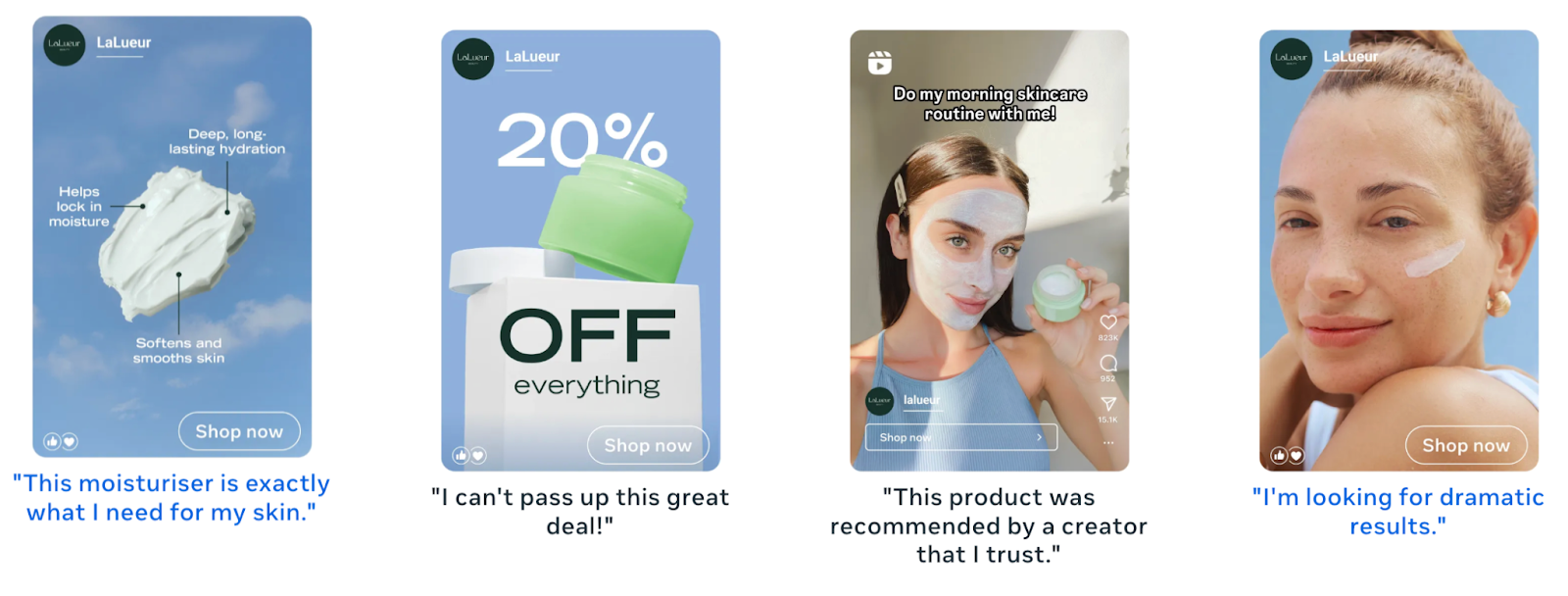
It’s meaningful shifts in how the message is expressed that can include:
- Highlighting different product benefits or use cases
- Testing multiple formats, from short-form video to static or carousel
- Changing tone and storytelling style: aspirational, practical, or creator-led
- Framing the value proposition in different ways
These kinds of differences give the platform something new to learn from, rather than repeating the same signal.
What Happens When You Get It Wrong
When that variation isn’t there, things start to compress. Ads compete against each other, signals become redundant, and the system has fewer ways to expand reach. Performance can plateau, and over time, fatigue sets in.
Meta’s research reveals that repeated exposure to similar creative tends to reduce engagement and conversion (about 45%), as audiences see the same message too often and stop responding to it. You need to focus on diversity over volume to avoid that. Ensure that each asset contributes something new, giving the platform more opportunities to find the right audience and sustain performance.
Building a Creative Diversity Pipeline
The brands that get this right don’t treat creative as a one-off effort but build a system around it.
Start with what’s already working
It usually begins with what’s already resonating. Organic social content is often the clearest signal, showing which messages, formats, and styles are connecting with your audience. This discovery phase gives you a foundation for creative content that has proven appeal.
Layer in new perspectives
Next, add inputs from creators, influencers, and user-generated content. These sources introduce new angles, formats, and storytelling approaches that your internal team might not produce on its own. They expand the range of ideas and give the platform more signals to work with.
Use paid to test and learn
Paid campaigns are where the creative is validated. Structured testing of truly distinct ideas, not minor variations, reveals what scales and what resonates with different audience segments.
Keep the loop going
The final piece is iteration. Insights from performance feed back into creative development, shaping the next round of ideas. Over time, this creates a continuous loop of testing, learning, and refining.
When this process is in place, creative diversity becomes consistent rather than reactive. And that consistency is what allows platforms to learn faster, match more effectively, and scale performance over time.
Final Thoughts
When paid social performance starts to slip, it usually doesn’t begin where most teams look. By the time results become inconsistent or harder to scale, something has already shifted earlier in the process, often at the creative level.
When there isn’t enough creative diversity in your ads, platforms have less to learn from and fewer ways to expand beyond the same audiences. Over time, that shows up as tighter reach, less stable performance, and campaigns that feel harder to sustain, even when everything else stays the same.
The brands that avoid this tend to approach ad creative differently. Instead of relying on more volume, they focus on introducing new angles, formats, and perspectives consistently, giving the social platform something new to work with as it learns and adapts.
And in the end, that’s where the difference tends to show up. Not in how much gets produced, but in how much variation those ideas actually bring.
Anja Pendic
Anja Pendic is the Content Marketing Specialist at Blue Wheel, where she plays a key role in creating and managing content for the company’s website. With extensive experience in digital marketing, copywriting, and social media management, she crafts engaging blogs, case studies, and landing pages. Anja has worked across various platforms, including Amazon, Meta, and TikTok, delivering impactful content and strategies.