
Blue Wheel has an established partnership with PowerBlock, a fitness brand best known for its adjustable dumbbell systems designed to replace entire racks of weights with a single, compact solution. Its customers range from serious lifters building out home gyms or training in pro training facilities to everyday users looking for convenience without sacrificing quality.
Like most modern consumers, they don’t follow a linear path to purchase. Discovery often starts on social, through creators, workouts, or product demos, before moving to search, reviews, and eventually a purchase on either the brand’s website or Amazon.
As PowerBlock scaled, its marketing ecosystem grew alongside to meet customers where they are. Paid social, Amazon advertising, paid search, creators, organic social, and lifecycle marketing all contributed to performance, each playing a role in driving awareness, engagement, and conversion.
The next phase required deeper coordination across these efforts, creating an opportunity for our teams to connect them more intentionally and drive compounding DTC growth across the customer journey.
When DTC Growth Becomes More Complex
High-growth eCommerce brands experience a common inflection point. As teams expand and channels scale, marketing becomes more specialized and complex.
PowerBlock entered Q4 with strong momentum, alongside the typical pressures of a competitive holiday shopping season. Acquisition costs were rising, requiring paid channels to maintain efficiency while continuing to scale.
The creator program was performing well but relied heavily on a small group of top-performing creators, making consistent scaling more challenging. At the same time, Amazon’s constraints introduced variability, underscoring the importance of having a strong DTC performance.
Each marketing function continued to deliver within its area:
- Paid media driving efficiency
- Creators producing content
- Organic social building engagement
- Lifecycle marketing supporting retention
For our specialized teams at Blue Wheel, the opportunity was to align these efforts more closely around a shared growth strategy. The focus was on strengthening how each element of the omni-channel approach worked together.
From Channels to a Unified Social & Growth System
Rather than continuing to optimize channels independently, the strategy evolved toward alignment. Our focus shifted from improving individual channels to making them work together as part of a unified social and growth system, rethinking how media, creative, and lifecycle marketing interact across the customer journey.
Once we took this approach, the goal moved beyond incremental gains toward building a structure that could support PowerBlock’s scalable, long-term DTC eCommerce growth.
Building a Full-Funnel Engine for DTC Growth
The next step wasn’t to add more channels or increase spend. Instead, our teams worked on improving coordination across the existing ecosystem.
Paid media was refined to support the full customer journey, from discovery through repeat purchase. Prospecting campaigns brought in new audiences, while retargeting and retention efforts converted high-intent users and maximized lifetime value, creating a more balanced approach between acquisition and efficiency.
Creative became a primary driver of performance. Video and lifestyle content captured attention at the top of the funnel, while promotional and product-focused assets supported conversion.
The full-funnel structure allowed each stage of the journey to reinforce the next, while improving both efficiency and scalability.
Scaling Content: Moving Beyond “Hero Influencers”
PowerBlock's previous reliance on a small number of high-performing creators limited scale and made consistent content production more difficult.
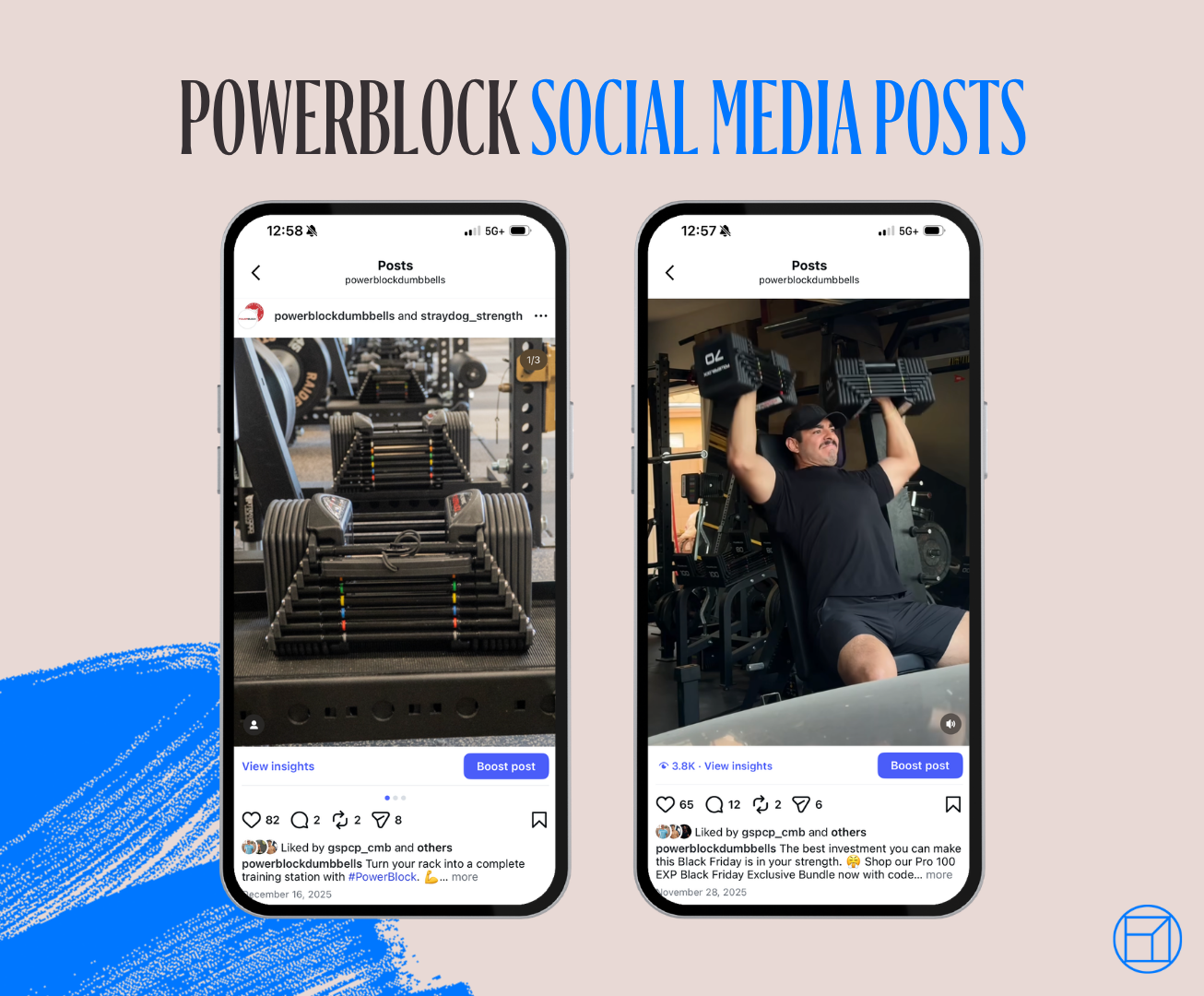
To support long-term growth, our strategy evolved toward an always-on creator ecosystem. Expanding partnerships across macro, mid-tier, and niche creators enabled a steady stream of diverse, authentic content, improving both output and reach.
We implemented a structured content framework (short-form video, demonstrations, lifestyle content) across Instagram, Facebook, and TikTok, using a high-frequency posting cadence.
This content extended beyond organic social. It became a key input for paid media, creating a continuous pipeline of high-performing assets that could be tested, optimized, and scaled across campaigns.
How a Unified Social Strategy Connects the Entire Funnel
As these elements became more closely aligned, each channel began reinforcing the others:
- Creator and organic content generated insights that informed creative direction.
- Paid media amplified top-performing assets, increasing reach and efficiency.
- Lifecycle marketing captured that demand, driving conversion and repeat purchases.
- Performance data was fed back into the system, shaping future creative and media decisions.
What emerged was a continuous growth loop where every channel contributed to and strengthened PowerBlock’s overall performance.
The Results of a Connected DTC Growth Strategy
As coordination improved, performance strengthened across the business.

Supported by Meta Advantage+ Shopping campaigns, Meta revenue exceeded Q4 goals by 57%, with a 6.73x return on ad spend and a nearly 24% decrease in cost per acquisition quarter-over-quarter. Google Performance Max and Shopping campaigns delivered a 16.39x Paid Search ROAS, reflecting both strong demand and improved efficiency.
The creator program more than doubled output, producing 108 assets and achieving a 6.97x influencer media value ROI, alongside a 51% increase in impressions. Social growth accelerated significantly, with PowerBlock reaching over 100,000 TikTok followers.
Organic social results in Q4 exceeded benchmarks, surpassing growth targets by 81% on Instagram and 76% on TikTok. Engagement rates were up 50% on Instagram and 453% on TikTok.
Lifecycle marketing was optimized through refined audience segmentation, revised flow setups, and more intentional sending strategies. This led to consistent year-over-year growth, with lifecycle revenue increasing by 18.5%, email campaign revenue by 23.5%, and flows revenue by 14.1%.
PowerBlock’s Q4 results were driven by a unified system designed for channels to build on one another.
Why This Approach Works for Scaling a DTC Brand
Many brands looking at how to scale a DTC brand focus on increasing spend or expanding into new channels. While those methods can drive short-term gains, they don’t always address the underlying challenge: coordination.
In PowerBlock’s case, performance improved because each component supported the others. Creative aligned with user intent at different stages of the funnel, channels shared insights, and content moved seamlessly across the customer journey.
Our shift in strategy and a new level of alignment transformed marketing efforts from a collection of activities into a cohesive growth engine.
What This Means for Brands
The key takeaway for brands focused on DTC eCommerce growth is that it rarely slows because channels stop working. More often, it slows because those channels are not working together as effectively as they could.
As the customer journey becomes more connected, aligning paid media, creator strategies, and lifecycle marketing becomes necessary. Brands that build systems, rather than simply scaling tactics, are better positioned to drive consistent, sustainable growth.
Final Thoughts
Scaling a DTC brand requires strong individual channels and, above all, alignment. A unified social and full-funnel strategy ensures that organic and creator content, paid media (search, Amazon Ads, and social), and lifecycle marketing work together to turn attention into revenue and drive long-term growth.
If your marketing efforts feel fragmented or if your DTC growth isn’t compounding, the issue is often how the channels work together. Building a unified system is what can help you boost performance.
What PowerBlock needed, and what we have achieved, was a more connected way to scale what was already working.
Want to turn your marketing channels into a unified growth engine? Let’s talk about how we can improve your brand’s performance.
Anja Pendic
Anja Pendic is the Content Marketing Specialist at Blue Wheel, where she plays a key role in creating and managing content for the company’s website. With extensive experience in digital marketing, copywriting, and social media management, she crafts engaging blogs, case studies, and landing pages. Anja has worked across various platforms, including Amazon, Meta, and TikTok, delivering impactful content and strategies.