

Retail growth looks very different from what it did just a few years ago. Budgets are under greater scrutiny, and performance expectations continue to rise. At the same time, customer acquisition costs (CAC) have increased by more than 60% over the past five years, with brands now paying anywhere from $45 to $250+ per customer, depending on their vertical.
For many brands, the challenge is clear: they’re working with the same budgets year over year, but are expected to deliver bigger growth targets. As acquisition becomes more expensive and less predictable, brands are rethinking how they drive performance. Instead of relying solely on acquiring new customers at scale, more are turning to retention as a more efficient path to growth, focusing on increasing customer value, driving repeat purchases, and getting more from the customers they already have.
Why Retention Is Back in Focus
Retention delivers what acquisition alone cannot: control. It creates more predictable performance, stabilizes revenue, and improves efficiency over time. Instead of constantly chasing new demand, brands can compound value from customers they’ve already acquired.
That shift is becoming increasingly important. While a 3:1 lifetime value (LTV) to CAC ratio is often considered healthy, most scaling eCommerce brands operate closer to 1.5–2.5x, leaving little margin for error and putting sustained pressure on profitability. Today, growth isn’t just about acquiring more customers but also increasing the value of the ones you already have.
There’s also a common disconnect in how retention is treated. It’s often the first area to be deprioritized when budgets tighten, despite being one of the highest-leverage investments a brand can make.
The opportunity is to rethink retention entirely, not as a set of campaigns, but as a system designed to grow customer value over time. Shift the focus from single transactions to long-term relationships, and from short-term conversion to sustained growth.
Why Most Retention Strategies Fall Short
While many brands use email, SMS, and loyalty programs, these efforts often underperform because retention is treated as a series of isolated campaigns rather than a continuous system. Teams frequently plan around one-off offers and seasonal events, creating fragmented customer experiences.
Data silos further restrict performance. Purchase history and engagement signals are often trapped in separate systems, forcing brands to rely on assumptions rather than personalized insights.
Organizational structure adds another layer. Lifecycle marketing, customer relationship management (CRM), social and paid media, and other teams often operate with different goals and metrics. Each function optimizes within its own scope, but there is little alignment around long-term customer value.
The result is a retention strategy that appears active but lacks coordination. Successful brands are structuring retention to connect data, experience, and communication into a system that compounds value over time.

The Retention Growth System
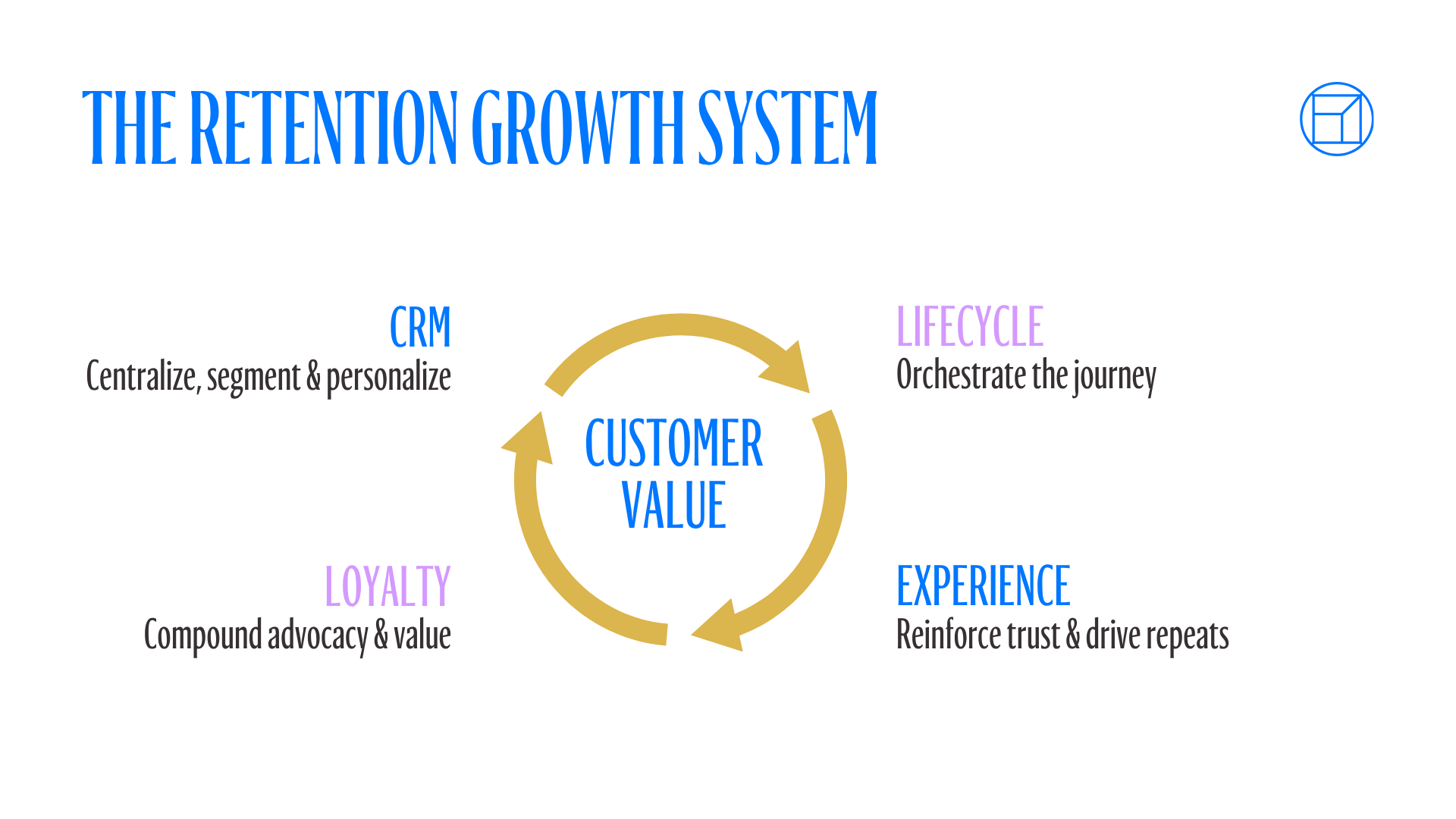
High-performing brands don’t treat retention as a single channel or tactic. Instead, they structure it as a connected system with four core components.
CRM serves as the foundation, centralizing and segmenting customer data to enable more informed decision-making. Lifecycle marketing builds on that data, orchestrating communication across the customer journey. Customer experience reinforces value at every interaction, shaping how customers perceive and engage with the brand. Loyalty programs extend that relationship further, turning engagement into repeat behavior and long-term advocacy.
When these elements operate together, retention functions as a system that compounds customer value over time and supports more consistent, predictable growth.
Build a Strong CRM Foundation Before Scaling Anything
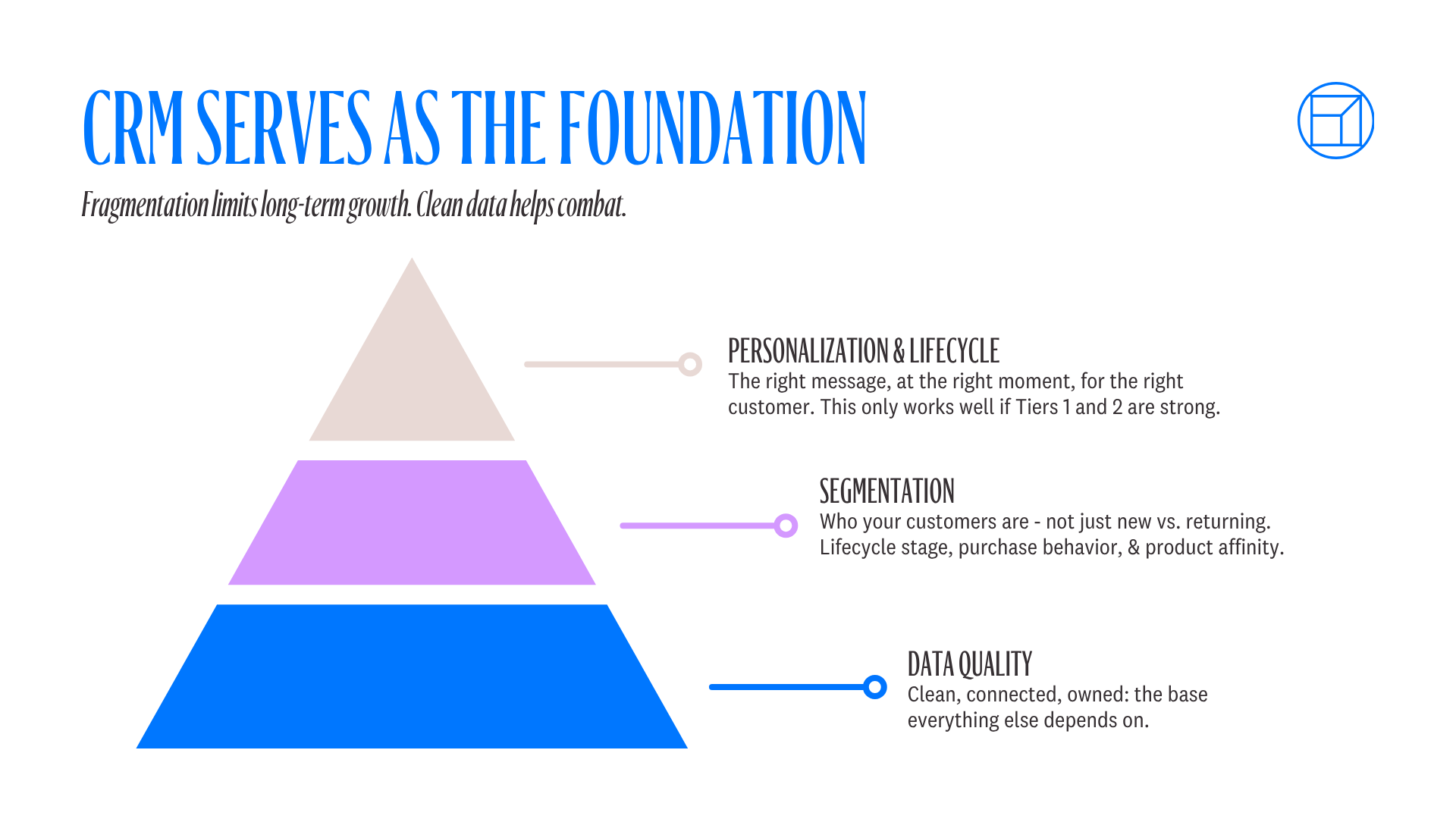
Your retention strategy depends on the quality of your customer data. Without a reliable foundation, brands struggle to scale lifecycle strategies or achieve meaningful personalization. Connected first-party data allows you to understand behavior beyond single transactions. When you unify this data, segmentation becomes more meaningful and messaging more precise.
Common challenges at this stage include:
- Customer data is spread across disconnected platforms
- Segmentation is limited to basic new vs. returning distinctions
- Data hygiene issues lead to inaccurate targeting
The way to overcome this is to consistently collect, unify, and activate data across all channels. Grounding efforts in real customer behavior makes the retention strategy more effective. While a strong CRM foundation doesn’t immediately increase revenue, it enables every downstream retention effort to perform at a higher level.
Shift From Promo Campaigns to Lifecycle Systems
Campaigns tied to promotions drive short-term engagement but lack the consistency for long-term behavioral change. Instead of one-off sends, brands need to shift to lifecycle systems.
This means building always-on journeys that respond to customer behaviors, like first purchase, replenishment, or disengagement, rather than just when you decide to communicate. This creates a continuous, timely, and relevant relationship that builds the trust essential for repeat purchases.
Key elements include:
- Behavior-based triggers tied to real customer actions
- Flows designed around stages in the customer journey
- Messaging that evolves based on engagement and purchase history
Structuring retention this way makes your performance more predictable.
Craft the Post-Purchase Customer Experience
The moment a customer completes a purchase plays a significant role in determining what happens next. The post-purchase experience sets expectations, reinforces value, and influences whether a customer will return.
Focus on guiding consumers beyond the transaction. Help them get value from their product and introduce reasons to engage again. Without clear guidance, even satisfied customers may not have a reason to return.
To strengthen post-purchase experience, make sure to include:
- Clear communication around order status and delivery
- Educational content that helps customers use the product
- Follow-ups that introduce complementary products or next steps
Customers who receive strong post-purchase support are more likely to buy again, with 93% saying excellent customer service makes them more likely to return.
Use Retention to Build Customer Intelligence
Your retention efforts generate insights that go beyond revenue. As you track customer interactions, patterns emerge around purchase frequency and engagement, revealing which segments create the most value.
Tracking these behaviors allows you to move beyond surface-level metrics and deeply understand your audience. Instead of treating all customers the same, you can identify meaningful segments and tailor your strategies accordingly.
For example:
- Differences in purchase cadence across categories
- Characteristics of high-value customers
- Signals that indicate churn risk or declining engagement
Use these insights to make your messaging more relevant, recommendations more effective, and your retention strategy more aligned with real customer needs.
Turn Loyalty into a Value Driver
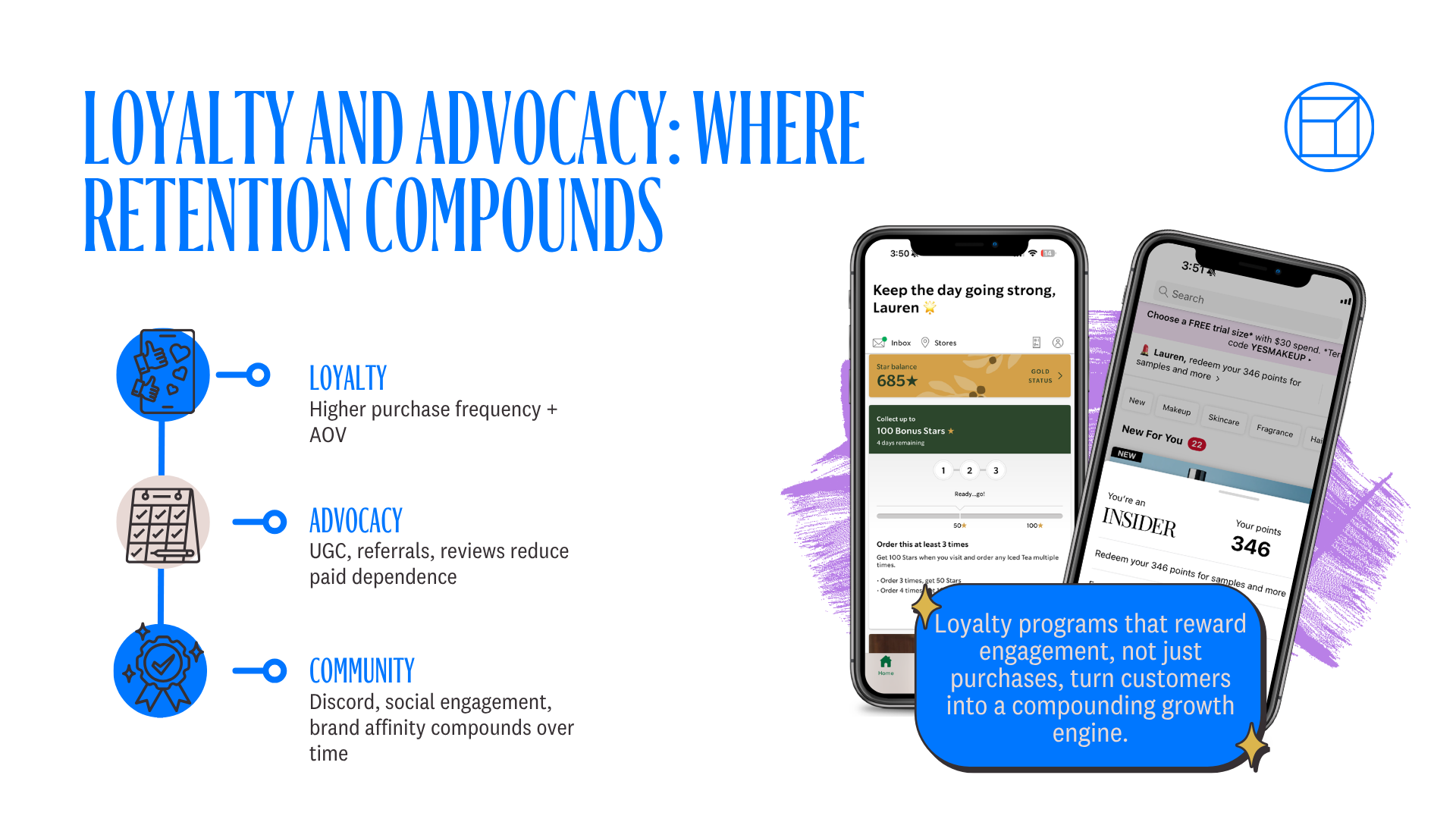
Loyalty programs are often introduced to incentivize repeat purchases, but their impact is limited when they rely only on discounts. While incentives can drive short-term behavior, they don’t always contribute to long-term value.
A stronger approach focuses on engagement, experience, and connection with the brand. Instead of rewarding only purchases, support behaviors that deepen the relationship.
This can include:
- Encouraging and rewarding reviews or referrals
- Recognizing repeat engagement across channels
- Creating opportunities for customers to feel part of a community
Loyalty built around value rather than discounts strengthens brand affinity and customer engagement, while reducing reliance on promotions.
Use Retention to Improve Acquisition Efficiency
Retention has a direct impact on acquisition performance, even though the two are often managed separately. Insights from existing customers can significantly improve how to approach new customer acquisition.
By understanding which customers generate the most value, you can refine targeting and focus on acquiring similar audiences.
Retention data can support acquisition by:
- Building lookalike audiences from high-value segments
- Excluding existing or low-value customers from prospecting
- Informing creative and messaging based on proven preferences
These connections create a more informed acquisition strategy grounded in real behavior.

Adapt to a Non-Linear Customer Journey
Customer journeys are becoming less linear, and AI-driven platform algorithms play a larger role in shaping interactions. As automation increases, brands have less direct control over targeting and optimization.
Distinctions between new and returning customers are less clear. Platforms optimize toward outcomes, often prioritizing lower-cost conversions without fully accounting for long-term value.
Build strong relationships with existing customers to create a demand source that is less dependent on platform behavior.
Adapting requires:
- Focus on customer value rather than isolated campaign performance
- Use of first-party data to guide decisions
- Building retention systems that operate independently of platform changes
Measure What Actually Matters
Many retention programs are evaluated using metrics that don’t capture their full impact. Open rates and click rates provide signals, but they don’t capture how retention contributes to long-term growth. A more effective approach focuses on metrics that reflect long-term customer value and business impact, rather than short-term engagement signals.
Key metrics include:
- Lifetime value (LTV)
- Repeat purchase rate (RPR)
- Time between first and second purchase
- Revenue from returning customers
Retention Only Performs as a System
While each of these strategies drives performance, their true impact is made only through integration. First-party data, lifecycle marketing, customer experience, and loyalty programs must function as a unified system to effectively influence and sustain long-term customer behavior.
When these elements are connected, retention becomes more consistent and scalable. CRM and data enable personalization, lifecycle drives engagement, experience builds trust, and loyalty reinforces ongoing interaction.

The brands seeing the strongest results are focused on increasing customer value over time and improving how retention connects back to acquisition and paid media performance, a central theme in our latest webinar with BWG Connect.
Find out where your brand is leaving LTV on the table across CRM, lifecycle, loyalty, paid media, and measurement.

FAQs
Why is retention becoming more important for retail growth?
Customer acquisition costs are rising, forcing brands to increase the value generated from existing customers for more efficient and predictable growth.
What is the main benefit retention delivers over acquisition?
Retention provides control and predictability by stabilizing revenue and compounding value from customers already acquired, rather than constantly chasing new demand.
Why do many retention strategies fall short?
They are often treated as a series of isolated campaigns, suffer from fragmented customer experiences due to data silos, and lack coordination between teams like lifecycle marketing and paid media.
What are the four core components of the Retention Growth System?
The system connects CRM (data foundation), lifecycle marketing (communication orchestration), customer experience (value reinforcement), and loyalty programs (long-term advocacy).
How should brands approach loyalty programs?
Loyalty programs should shift focus from relying only on discounts to supporting behaviors that deepen the relationship, such as rewarding reviews, referrals, and community engagement.
What key metrics reflect the true impact of retention?
The most effective metrics reflect long-term customer value and business impact, including Lifetime Value (LTV), Repeat Purchase Rate (RPR), and revenue from returning customers.

Anja Pendic is the Content Marketing Specialist at Blue Wheel, where she plays a key role in creating and managing content for the company’s website. With extensive experience in digital marketing, copywriting, and social media management, she crafts engaging blogs, case studies, and landing pages. Anja has worked across various platforms, including Amazon, Meta, and TikTok, delivering impactful content and strategies.




.png)
.png)
.avif)