
In recent years, retail media measurement has undergone a fundamental shift, and Amazon, with its advanced analytics tools such as Amazon Marketing Cloud (AMC), is leading that change. Amazon Flexible Shopping Insights (FSI), a paid subscription-based capability within AMC, gives advertisers aggregated visibility into how shoppers browse, compare, and purchase across brands and categories.
Instead of focusing purely on campaign-level performance, FSI enables brands to analyze how shoppers move across their brands, compare products, and convert over time within AMC’s privacy-safe environment.
For brands navigating increasingly complex retail media ecosystems, this shift unlocks a deeper understanding of competitive dynamics, category entry points, and the real drivers of growth. And for advanced advertisers, it signals a move toward more strategic, data-informed decision-making. This reflects a broader change in how performance needs to be measured.

What Is Amazon Flexible Shopping Insights (FSI)?
Amazon Flexible Shopping Insights is an advanced analytical capability built within AMC that allows advertisers to explore aggregated shopper behavior across brands, categories, and campaigns. It is offered as a paid add-on, with pricing varying based on data and traffic volume. A 60-day free trial is available within AMC Paid Features.
Unlike standard reporting dashboards, FSI operates inside a privacy-safe clean room, where event-level signals, such as impressions, clicks, and purchases, are anonymized and aggregated. This ensures compliance while still enabling deep behavioral analysis.
Flexible Shopping Insights is best suited for:
- Brands exploring organic and paid media interactions in purchase behavior
- Advertisers using Sponsored Ads and Amazon DSP
- Brands looking for Amazon Subscribe & Save insights
- Brands focused on incrementality and NTB growth
- Teams with AMC or data science capabilities
- Media buying brands
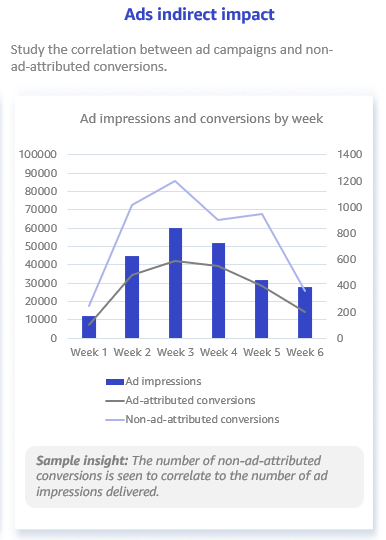
The introduction of FSI addresses the growing limitations of traditional attribution models. As shoppers interact with multiple brands, formats, and touchpoints, last-click reporting fails to capture the full picture. FSI fills that gap by providing cross-channel, cross-category visibility into real shopper journeys on Amazon.
Source: Amazon Ads
What Flexible Shopping Insights Actually Expands
Standard Amazon reporting is built around ad-attributed activity. That creates a narrow lens on performance that emphasizes exposure while missing a large portion of shopper behavior. Flexible Shopping Insights extends that lens by incorporating aggregated signals that include both paid and organic interactions. Brands can analyze:
- Product views and repeat engagement
- Add-to-cart activity outside ad exposure
- Purchases that are not directly tied to campaigns
This makes it possible to trace how shoppers engage, how interest builds, and how different interactions contribute to conversion over time. FSI helps connect previously fragmented shopper behavior into a unified view. “Flexible Shopping Insights allows us to understand the organic interactions in between paid interactions. It helps us close the loop and understand how customers actually move through the journey,” says Jake Smith, Enterprise Account Manager at Blue Wheel.
Measurement Is Shifting from Outcomes to Behavior
Campaign metrics (ROAS, CTR, conversions) show what happened after an interaction, but they do not explain how a shopper arrived at that decision. With Amazon Flexible Shopping Insights, advertisers can analyze behavior across the full journey. Brands can observe how shoppers move between products, how often they return, and how multiple interactions influence purchase decisions.
Instead of optimizing toward isolated outcomes, brands can evaluate how sequences of behavior contribute to conversion and long-term value. Strategy becomes informed by how demand is formed, rather than reacting to isolated outcomes. Most brands are still optimizing within the limits of campaign reporting, even as shopper behavior has moved far beyond it. That gap is where competitive advantage is starting to emerge.
As Jake Smith explains, “Gone are the days of evaluating upper-funnel campaigns on CPM or video completion rates alone; we can now see how those interactions actually contribute to purchases.”
Shopper Behavior Data Influences Brand Strategy
With AMC Flexible Shopping Insights, brands can analyze which of their products are viewed together, how often shoppers switch between options, and where they ultimately convert. This helps build a more evidence-based view of the shopper’s consideration set within the Amazon environment.
Customer behavior data offers a practical lens on competition by revealing co-viewing patterns, switching behavior, and conversion paths. While this does not represent the full market or capture off-platform influences, it provides a more grounded alternative to assumption-based category definitions.
Brand strategy should be informed by observed behavior and complemented by a broader context. Messaging, targeting, and product prioritization become more relevant when they reflect how shoppers are actually comparing options, while still accounting for brand positioning, external research, and other drivers beyond what behavioral data alone can show.
Audience Strategy Is Becoming Behavior-Led
Audience segmentation is also evolving. Exposure-based audiences capture who has seen an ad. They do not capture intent with much precision. Brands can use Flexible Shopping Insights to build audiences based on behavior signals such as repeated engagement, product interaction, and purchase intent.
This leads to more relevant targeting and better allocation of media spend. Instead of relying on broad segments, brands and advertisers can focus on shoppers who are actively demonstrating interest within the category. Audiences are defined by what shoppers do, not just by whether they were reached. “What we can pull out of Flexible Shopping Insights is cohorts of consumers that behave differently: those who buy during everyday periods and those who only purchase during key events,” adds Jake Smith.
Understanding the Full Path to Purchase
Last-touch attribution compresses a complex journey into a single interaction. That simplification becomes more problematic as shopper behavior becomes more fragmented.
Flexible Shopping Insights provides visibility into the full sequence of interactions leading to conversion. Brands can analyze how long it takes for shoppers to convert, how often they engage before purchasing, and how different touchpoints contribute along the way.
A meaningful portion of conversions occurs outside standard attribution windows. Without a broader view, those interactions are undervalued or missed entirely. Better visibility into the path to purchase reveals how timing, frequency, and repeated exposure influence conversion.
A Practical Example from the Haircare Category
For our client, a leading brand in the haircare category, we used AMC Flexible Shopping Insights to analyze shopper behavior over 12 months, comparing ad-exposed and non-ad-exposed audiences. Several consistent patterns emerged.
A large share of purchases (85%) occurred after at least one ad exposure, indicating that media played a role in driving demand rather than simply capturing it. Shoppers who were exposed to ads purchased more frequently over time and were 2x more likely to buy multiple products in a single transaction.
Conversion timing also varied. Many shoppers converted quickly (70% in the first day), while a meaningful portion returned days or weeks later to complete a purchase.
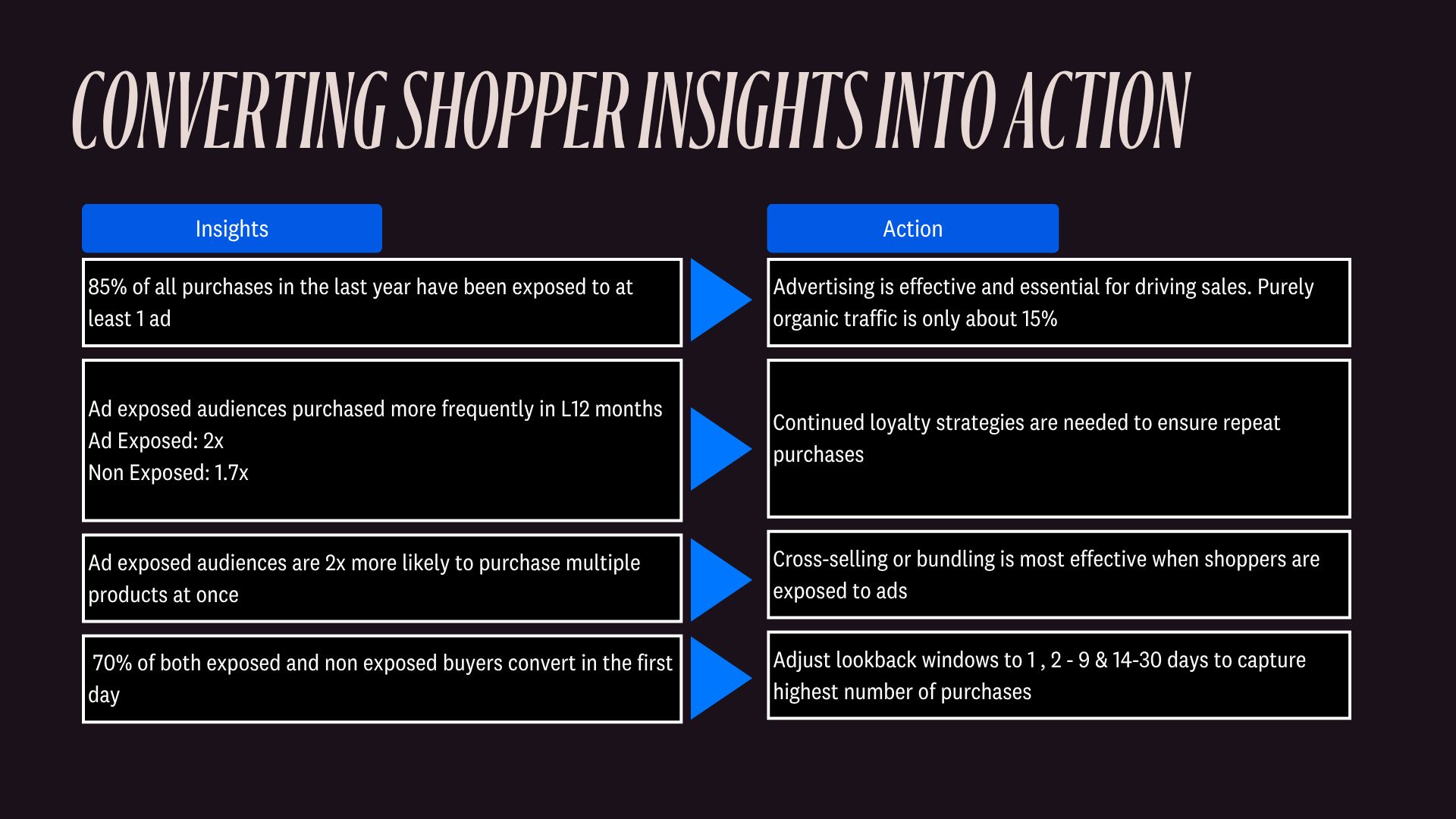
These insights revealed a more complex journey than standard reporting suggests, where immediate conversions represent only part of the picture and repeat engagement and delayed decisions play a significant role.
We converted insights into tactical actions by expanding measurement windows, supporting earlier-stage engagement, and aligning media with cross-sell and repeat purchase behavior.
With a clearer understanding of how shopper behavior evolved over time, the team improved efficiency by aligning strategy with actual shopper decision patterns.
Where Flexible Shopping Insights Drives Impact
When applied effectively, Flexible Shopping Insights supports several strategic improvements:
- More accurate alignment between media investment and the full shopper journey
- Stronger audience targeting based on behavioral signals
- Improved visibility into repeat purchase patterns and long-term value
These are powerful capabilities that can influence how strategy is built across planning, execution, and measurement.
What Most Brands Still Get Wrong
Access to deeper measurement does not automatically lead to better decisions, and many brands continue to rely on familiar performance metrics even after adopting AMC and FSI. As a result, decisions are still driven by short-term efficiency rather than a full understanding of shopper behavior.
This creates a disconnect between what teams can analyze and how they actually operate, and several patterns tend to emerge:
- Optimization remains focused on immediate return metrics, even when data shows delayed conversion and repeat engagement
- AMC is used primarily for reporting rather than as an input into planning and investment decisions
- Upper-funnel activity is measured, but not consistently supported in budget allocation
- Insights are generated but not tied to clear actions or test-and-learn frameworks
Flexible Shopping Insights expands visibility, but the advantage comes from how that visibility is translated into action.
How to Start Using Flexible Shopping Insights
A focused approach is more effective than trying to analyze everything at once. The goal is to connect insight directly to action.
Here’s a practical starting point:
- Start with how long it takes shoppers across both organic and paid to convert, or how often they return before purchasing
- Identify one meaningful behavior, such as repeat product views, add-to-cart activity, or delayed conversion
- Translate that insight into a specific change in targeting, messaging, or budget allocation
- Measure how performance shifts after that change is implemented
Keep analysis connected to execution. Over time, this creates a more structured way of using behavioral data to inform strategy.
Capability Comes with Complexity
Flexible Shopping Insights requires a higher level of analytical maturity than standard reporting. Brands need access to Amazon Marketing Cloud and the ability to work within a query-based (SQL) environment.
More importantly, they need a clear approach to interpreting behavioral data, as insights don’t translate into value on their own. The advantage comes from applying them to decisions around targeting, messaging, and investment.
For teams without in-house analytical resources, building this capability internally or working with partners who specialize in AMC can accelerate adoption and impact.
Final Thoughts
Retail media measurement is evolving toward a behavior-first model, where understanding how shoppers move through a journey matters as much as the outcome.
Amazon Flexible Shopping Insights reflects this shift by connecting paid and organic interactions within Amazon Marketing Cloud and making those behaviors visible in a more complete way. Instead of focusing only on what converts, brands can begin to understand how demand is created, influenced, and ultimately captured over time.
The advantage is now defined by how effectively data is used to inform decisions. The brands that translate AMC and Flexible Shopping Insights into action will be better positioned to compete as shopper journeys become more complex and less predictable.
Anja Pendic
Anja Pendic is the Content Marketing Specialist at Blue Wheel, where she plays a key role in creating and managing content for the company’s website. With extensive experience in digital marketing, copywriting, and social media management, she crafts engaging blogs, case studies, and landing pages. Anja has worked across various platforms, including Amazon, Meta, and TikTok, delivering impactful content and strategies.