
Many eCommerce brands eventually reach the same moment in their social media strategy: leadership looks at the numbers and asks, “Why isn’t social driving revenue?” In many cases, the issue isn’t the platform or the content, but a structural fragmentation.
Different social functions, such as organic, creators, paid media, and commerce, often operate as separate efforts inside the same organization. Each team may be performing well individually, but without shared objectives and coordinated creative systems, the full impact of social is underutilized.
The result is a structural gap between how social is managed internally and how customers actually move through the buying journey today.
A unified social strategy closes that gap. By aligning discovery, trust, conversion, and retention into a single system, brands can transform social from a collection of channels into a coordinated growth engine that supports revenue generation.
Why Social Becomes Harder to Scale Over Time
Most brands find social media growth follows a predictable curve: organic content informs and connects, paid ads are effective, and creator collaborations drive buzz. But over time, momentum slows. Performance becomes harder to sustain, costs increase, and leadership begins asking tougher questions about return on investment.
At first, it can appear that social platforms have simply become more competitive. In reality, the underlying issue is often structural.
Social is now expected to behave like a performance channel, driving measurable business impact and contributing to revenue growth. Yet inside many organizations, the teams responsible for organic social, paid media, creator partnerships, and commerce initiatives remain organized as separate functions with separate KPIs.
Organic teams focus on engagement and audience growth. Paid teams are evaluated on ROAS and acquisition costs. Creator programs are judged by reach or deliverables. Individually, these goals make sense. Collectively, they rarely align with how customers actually discover, evaluate, and purchase products today.
As the path from discovery to purchase continues to compress, particularly with the rise of social commerce and in-platform shopping, these structural gaps become more visible. Insights fail to travel between teams, creative performance becomes harder to sustain, and the full impact of social influence remains fragmented across the organization.
Social itself hasn’t become less effective. The buying journey has simply become more compressed and connected than the organizational structures managing it.
The Social Alignment Gap Explained
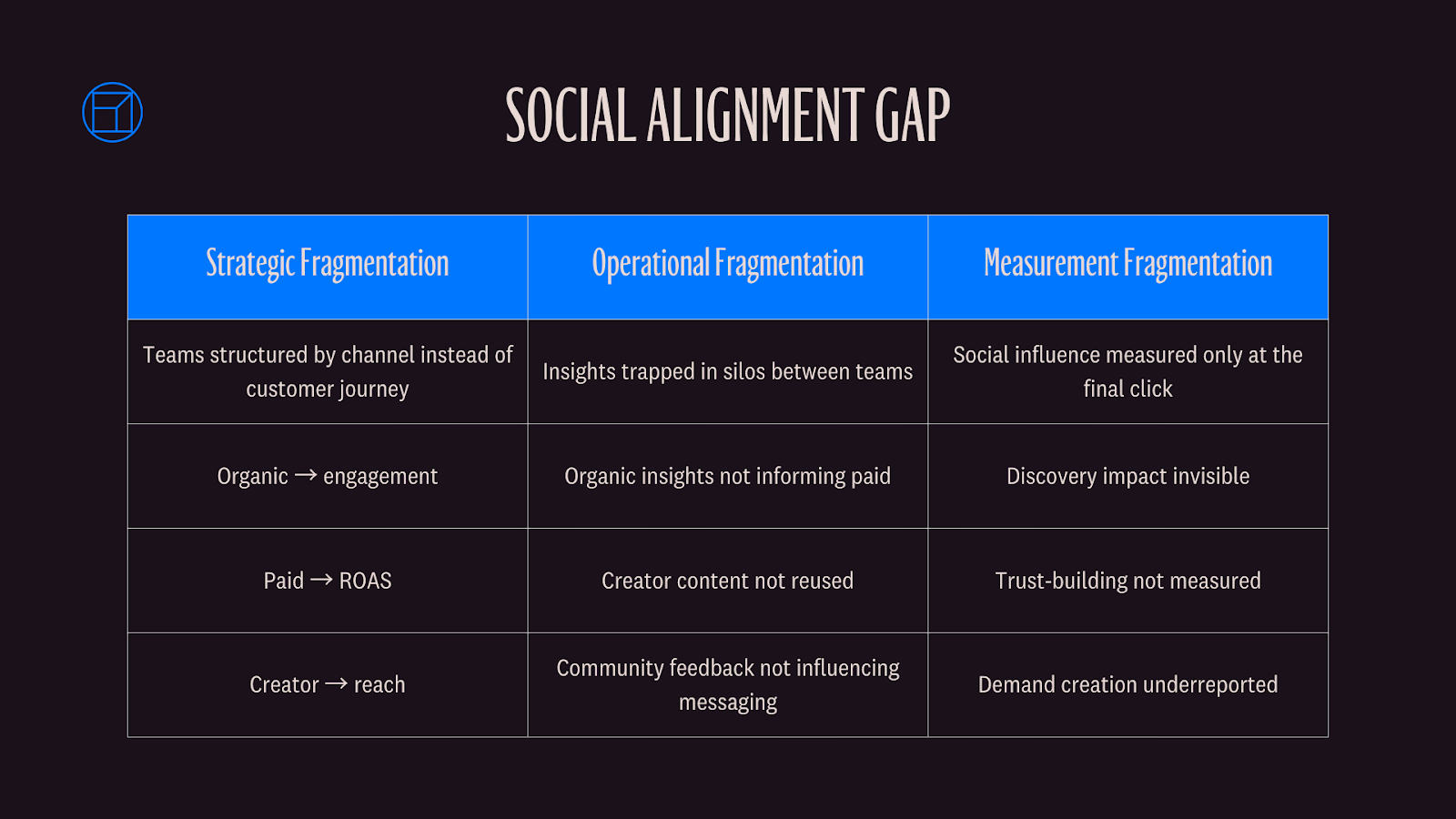
The social alignment gap appears when organic, paid, creator, and social commerce operate as parallel efforts rather than a coordinated system. Each team may deliver strong results in isolation, but without shared objectives and structured collaboration, the overall growth potential remains limited.
This gap typically emerges in three areas: strategy, operations, and measurement.
Strategic Fragmentation
Organizations often structure social initiatives by channel, leading to fragmented optimization. Organic teams focus on engagement, while paid teams aim for return on ad spend. Leadership expects a unified approach that contributes to revenue growth.
Without a shared performance narrative across awareness, conversion, and retention, efforts may be misinterpreted. For example, organic strategies can generate demand captured by paid efforts, making them appear underperforming.
Similarly, creator content influences purchases but lacks integration with paid strategies, limiting its effectiveness. This fragmentation indicates structural misalignment with modern social discovery.
Operational Fragmentation
Even with strategic alignment, operational silos prevent social insights from moving between teams. High-performing organic content doesn't inform paid creative fast enough. Creator and UGC content is treated as campaign output, not reusable assets. Community feedback rarely updates product pages or conversion efforts.
This lack of deliberate feedback traps insights, leading to slower creative iteration, rising paid media costs, and creative fatigue, often mistaken for a content problem when it's a coordination failure.
Effective social media teams view content as an ongoing system: organic informs paid testing, creator output becomes a performance asset, and community feedback drives messaging and conversion improvements. The real advantage lies in connecting insights across the ecosystem, not just producing more content.
Measurement Fragmentation
Measurement is where the alignment gap becomes most visible. Many brands still evaluate social performance primarily through last-click attribution or platform-reported conversions. While important, these metrics were designed for channels focused on capturing demand rather than generating it.
Social influences consumer behavior much earlier in the journey. Discovery, trust-building, and product validation often occur long before the final click that triggers a purchase.
When measurement frameworks ignore this upstream influence, social appears to contribute less than it actually does. Leadership may see paid efficiency declining or organic revenue appearing minimal, even while social activity appears to correlate with increases in branded search, higher-quality traffic, or stronger conversion performance across other channels.
This creates a cycle where investment decisions are based on incomplete signals. Social often isn't failing; its measurement model simply doesn't capture its full role in shaping demand.
What Unified Social Actually Means
A unified social strategy does not simply mean producing more content or increasing paid media budgets. Instead, it reflects a shift in how brands think about social media’s role in the broader growth system.
Rather than operating as separate channels, social programs perform best when they contribute to a few core functions that support the customer journey.
High-performing brands often organize their social efforts around several key dynamics.
Shared Audience Signals
Every social interaction generates insight. Engagement patterns, comments, creator responses, and community conversations reveal what messaging resonates and what questions consumers still have.
When these signals are surfaced and shared across teams, they can inform creative direction, product messaging, and campaign strategy. Instead of remaining isolated within social channels, these insights help shape broader marketing decisions.
Creative Velocity
Social platforms reward content that feels fresh, relevant, and authentic. Maintaining performance, therefore, requires a continuous flow of creative input.
Creative velocity often comes from multiple sources: brand content, creator collaborations, user-generated content, and community interactions. When brands treat content as an evolving system rather than a fixed set of assets, they are better positioned to sustain engagement over time.
Amplification Through Paid Media
Paid social plays an important role in extending the reach of content that already resonates with audiences.
Instead of developing paid creative in isolation, many brands identify content that performs well organically or through creator partnerships and then amplify those messages to reach broader audiences. This approach allows paid media to build on existing audience signals rather than starting from scratch.
Reduced Friction to Purchase
Social commerce features help shorten the path from discovery to purchase by allowing consumers to explore products directly within social environments.
While not every purchase happens in-platform, these capabilities create additional entry points into the buying journey and allow brands to capture consumer interest at moments of high intent.
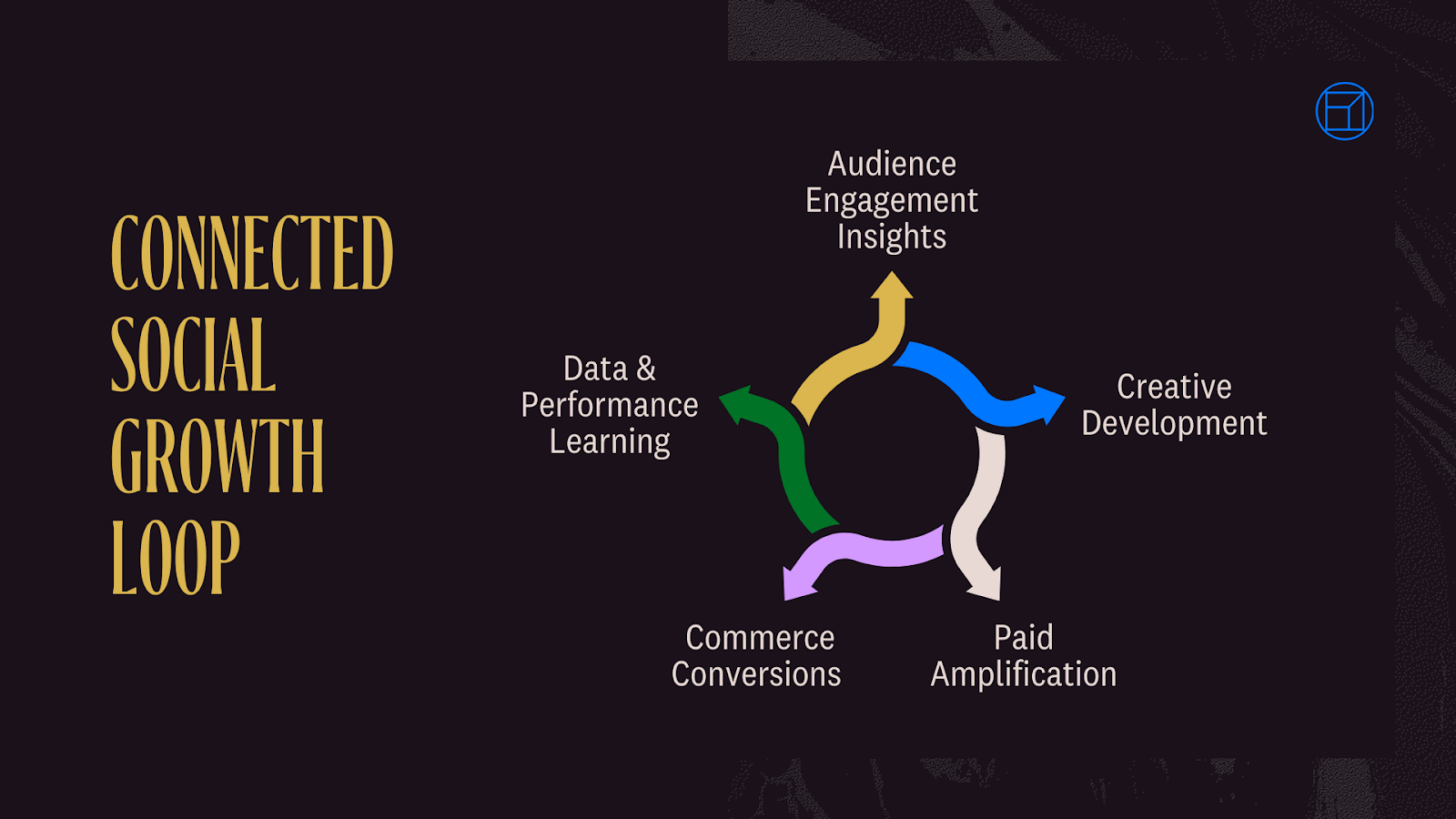
When these elements work together, social becomes less about managing individual channels and more about supporting a connected growth loop. Insights from audience engagement shape new creative, strong creative fuels paid amplification, and commerce features help convert interest into action.
Creative Fatigue and Limited Creative Diversity
When social performance declines, rising media costs are often blamed first. However, the underlying issue is often creative fatigue or a lack of creative diversity.
Social platforms reward fresh, engaging content that captures attention quickly. When brands rely on a limited set of creative assets or variations that feel too similar, audience engagement declines, and advertising efficiency drops.
Creative fatigue typically occurs when content production is treated as a series of deliverables rather than an ongoing system. Without a structured pipeline for testing and iteration, paid campaigns quickly exhaust available creative variations.
High-performing brands address this challenge by building repeatable creative processes:
- Organic insights help identify content themes and formats that can be tested in paid campaigns
- Creator partnerships introduce new perspectives and storytelling formats
- Paid teams test creative variations to identify messages that resonate with new audiences
Creator & UGC Content as a Performance Engine
Creator and user-generated content (UGC) have evolved far beyond awareness-driven influencer campaigns. Today, they are the most effective sources of scalable, performance-ready creative.
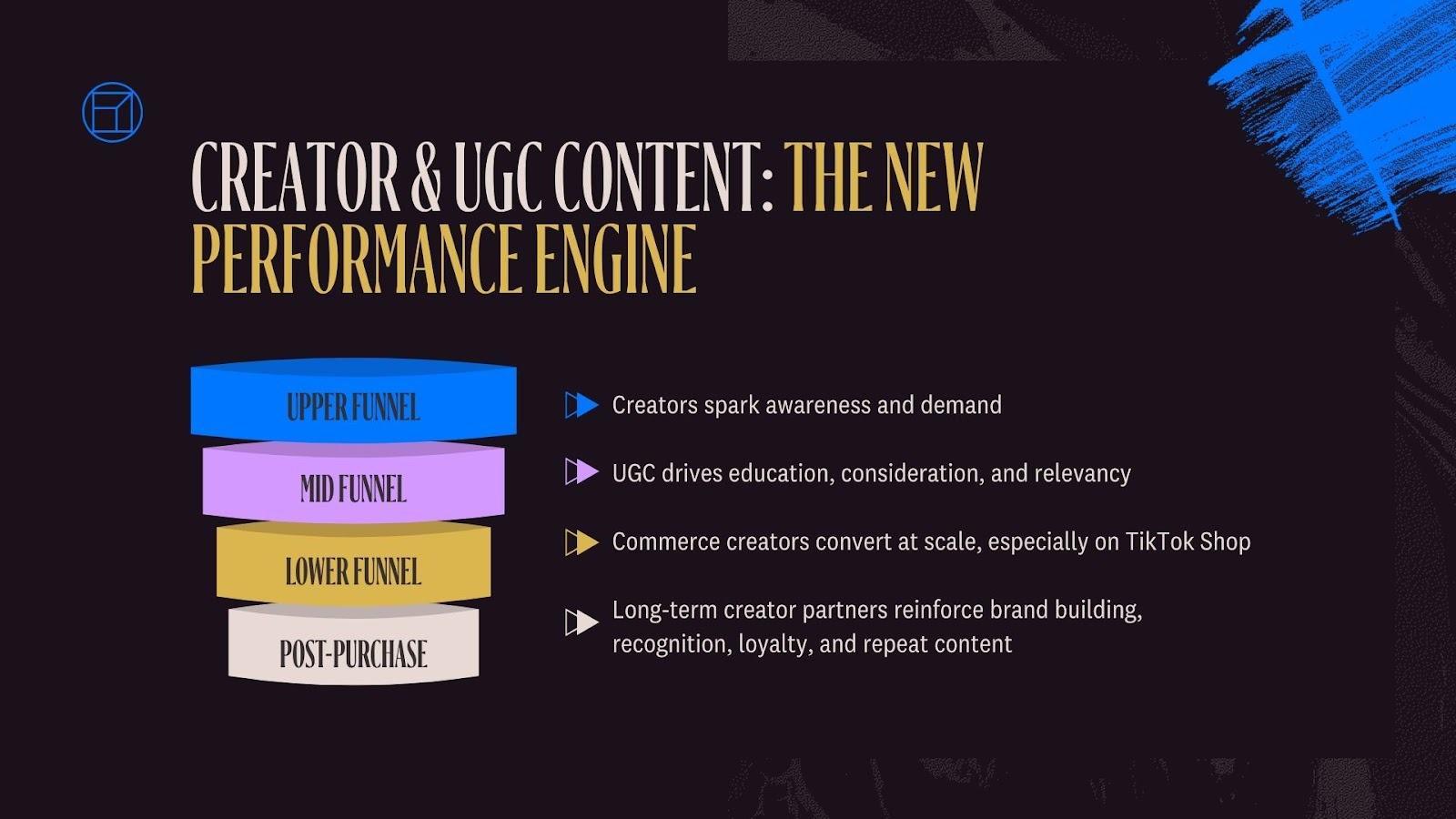
Authentic creator content often resonates more strongly with audiences because it reflects real product experiences and natural storytelling formats. This authenticity makes it particularly effective in social environments where traditional brand messaging can feel overly polished or promotional.
For brands, this content provides a valuable creative resource that can be repurposed across both organic and paid social media channels. High-performing creator videos, testimonials, and product demonstrations can be amplified through paid media, tested with new audiences, and optimized based on performance insights.
When integrated strategically, creator ecosystems become a continuous source of new content that fuels testing, prevents creative fatigue, and supports sustained performance growth.
Social Commerce Is a Conversion Layer
Platforms like TikTok Shop now offer integrated shopping features, such as product tagging in videos and livestreams, in-app storefronts on brand profiles, and native checkout experiences. These capabilities allow consumers to discover and purchase products without leaving the app.
In practice, the impact of TikTok Shop often extends beyond in-platform transactions. Content created for the app frequently drives discovery and product interest that later converts on brand websites, Amazon listings, or retail channels. For that reason, brands should evaluate TikTok Shop not only by direct in-app sales but also by its broader influence on demand generation across channels.
One challenge many organizations face is determining where social commerce initiatives should live internally. TikTok Shop often sits between social media and marketplace teams, which can create uncertainty around ownership, budgets, and performance metrics. Treating social commerce as part of a unified social system helps prevent this fragmentation and ensures that content, creators, and paid amplification are aligned around shared revenue goals.
These dynamics highlight a broader strategic shift. Social commerce should not be treated as a separate marketing channel. Instead, it functions as a conversion layer within the broader social ecosystem. Content drives discovery. Creator endorsements build trust. Paid media scales reach. Social commerce features then reduce friction by enabling immediate product exploration and purchase.
When these elements are aligned, brands can shorten the path from engagement to transaction while capturing demand at the moment of highest consumer intent.
Measuring Social’s Broader Influence
Traditional last-click attribution models often underestimate the role social media plays in shaping purchase decisions. Much of social’s influence happens earlier in the customer journey, where content drives awareness, builds credibility, and encourages product exploration.
Because these interactions do not always result in immediate conversions, their impact can be difficult to isolate within standard reporting frameworks.
Instead of relying on a single metric, many brands observe directional signals that indicate growing consumer interest. Shares, saves, and comment sentiment can provide useful context for how audiences respond to social media content.
Changes in site traffic patterns, branded search activity, or overall conversion performance may reflect the broader influence of social activity across the customer journey. While no single measurement approach captures the full impact of social, evaluating these signals together can help brands better understand how social contributes to long-term demand generation.
What Alignment Looks Like in Practice
When social strategies are aligned, each component of the ecosystem plays a defined role in a continuous feedback loop:
- Organic content and community engagement reveal emerging trends, audience sentiment, and messaging that resonates with consumers.
- Creator partnerships generate authentic product storytelling and expand creative diversity.
- Paid media teams test and scale high-performing content to reach broader audiences.
- Website and CRM channels convert this interest into sales while nurturing long-term customer relationships.
Insights generated from each stage feed back into the system, informing future content production, targeting strategies, and campaign optimization.
This continuous cycle enables brands to move beyond isolated campaigns and instead build a dynamic social engine that learns and improves over time.
The Competitive Advantage of Unified Social
Brands that close the social alignment gap gain advantages that extend well beyond individual campaign performance.
Unified strategies enable teams to reduce creative fatigue by maintaining a consistent pipeline of fresh content. Paid media becomes more efficient because campaigns are fueled by proven organic insights and authentic creator content. Traffic quality improves as social engagement drives higher-intent audiences to brand websites and product pages.
Most importantly, alignment shortens the distance between discovery and purchase. Consumers encounter consistent messaging across organic content, creator recommendations, paid campaigns, and commerce experiences, making it easier to move from interest to transaction.
Over time, this cohesion strengthens brand trust and improves customer acquisition efficiency.
Final Thoughts
Social media itself is not failing as a marketing channel. What often fails is how social programs are structured inside organizations.
When organic content, paid media, creators, and commerce initiatives operate in isolation, brands lose the ability to connect discovery, trust, and conversion into a cohesive customer journey. The result is fragmented performance and limited visibility into social’s true impact.
Brands that align these components transform social from a collection of tactics into a unified growth engine. The brands that succeed are not necessarily the ones producing the most content or spending the most on media. They are the ones structuring social as a connected system where insights, creatives, and performance continuously inform each other.
Want to elevate your social media strategy and achieve better results? Connect with Blue Wheel today to see how we can help you create a cohesive system that drives growth.
Anja Pendic
Anja Pendic is the Content Marketing Specialist at Blue Wheel, where she plays a key role in creating and managing content for the company’s website. With extensive experience in digital marketing, copywriting, and social media management, she crafts engaging blogs, case studies, and landing pages. Anja has worked across various platforms, including Amazon, Meta, and TikTok, delivering impactful content and strategies.