
Product Detail Page (PDP) optimization has traditionally been about rankings and conversion rates. In a Generative Engine Optimization (GEO) context, its role is broader and more strategic. PDPs have become training inputs for large language models (LLMs), AI shopping assistants, and recommendation engines. Clear product explanations, consistent attribute presentation online, and customer validation influence recommendations within AI Overviews, AI Mode, ChatGPT, Perplexity, and more.
What PDP Optimization Means in a GEO Context
At its core, PDP optimization for GEO means structuring product information so AI systems can clearly understand, validate, and confidently recommend a product. Instead of optimizing solely for human readers or search crawlers, brands now need to consider LLMs and AI tools that summarize options, answer product questions, and influence buying decisions upstream.
AI systems don’t evaluate PDPs the way people do. They synthesize signals across product descriptions, attributes, reviews, FAQs, and external mentions to form a probability-based judgment: Is this product relevant, credible, and safe to recommend?
When these signals lack clarity, consistency, or strong validation, AI systems will hesitate, resulting in a reduced probability of your content being surfaced in recommendations.
The Importance of Clarity, Consistency, Reviews, & Authority
Several factors directly affect how PDPs perform in GEO environments:
- Clarity of product explanation: PDPs that clearly articulate what a product does, who it’s for, and how it solves a problem are easier for AI systems to map to intent-driven queries. Benefit-led, natural-language descriptions outperform dense or overly technical copy because they reduce ambiguity.
- Completeness and consistency of product attributes: Structured, consistent attribute data helps LLMs and AI features reconcile information across channels. Gaps or inconsistencies introduce uncertainty, which lowers recommendation confidence.
- Strength and pattern quality of reviews: Customer reviews act as external validation layers. Some AI systems look for recurring themes, sentiment stability, and alignment between PDP claims and real customer experience.
- Authority and trust signals: Expert mentions, PR, and credible brand coverage reduce perceived risk for AI models making product recommendations.
PDP Content: Clarity, Attributes, & Natural Language
What PDP Content Is
Product Detail Page content is the set of signals that explain a product to both shoppers and machines. It includes product titles, descriptions, attributes, specifications, images, videos, FAQs, and supporting content that answers the question every buyer (and AI system) is asking: What is this, and is it right for me?
In eCommerce, PDP content has always influenced discoverability. Traditionally, that meant keyword relevance, crawlability, and on-page SEO signals. In a GEO environment, PDP content plays a broader role. It becomes the primary source of truth that AI systems rely on to understand a product’s purpose, relevance, and credibility.
Well-structured PDP content reduces ambiguity. Interpretation gaps arise from content that is poorly structured, has thin descriptions, includes fragmented attributes, or uses overly technical language. These gaps reduce the confidence of AI systems, making it difficult for them to include the product in generative answers or recommendations. Brands should strive to create PDP content that is easy to interpret and trust at scale.


How LLMs Parse PDP Content
Large language models don’t read PDPs line by line. They identify patterns and relationships across content elements to determine whether a product fits a given query or use case. In practice, this evaluation happens in four key ways:
Extract features
LLMs identify concrete product attributes such as ingredients, materials, dimensions, compatibility, or technical specifications. These features form the factual backbone of a product’s identity. Missing or inconsistent attributes weaken this foundation and introduce uncertainty.
Identify benefits
AI systems look beyond raw features to qualities such as comfort, durability, performance, and ease of use. PDPs that explicitly connect features to benefits reduce guesswork and make it easier for AI to explain why a product is relevant.
Map content to user intent
LLMs align PDP language with intent-driven queries. Natural-language descriptions that reflect how people actually search and ask questions (e.g., “for sensitive skin,” “for long-distance running”) map more effectively than keyword-stuffed or purely technical copy.
Infer audience and use case
PDP content signals who the product is for and how it’s meant to be used. Tone, terminology, examples, and supporting content help AI systems distinguish between beginner products, enthusiast gear, or professional-grade solutions.
What This Means for Brands
LLMs can’t reward what they can’t understand. If PDP content is unclear, overly complex, or written for internal teams instead of customers, AI systems struggle to confidently recommend the product. Brands that translate attributes into natural-language benefits reduce ambiguity and improve GEO performance.
Reviews: Sentiment, Patterns, & Predictive Value
Reviews are one of the strongest external validation signals available to AI systems. While shoppers read reviews to confirm a purchase decision, LLMs analyze them to assess credibility, consistency, and real-world performance.
In a GEO context, reviews function as a distributed extension of the PDP. They either reinforce what the brand claims or quietly undermine it.
What Review Signals LLMs Use
LLMs don’t evaluate reviews in isolation. They synthesize review data across multiple dimensions, including:
- Volume: A healthy volume of reviews increases confidence that feedback reflects real customer experience rather than outliers.
- Recency: Recent reviews signal product relevance and help AI systems assess whether claims still hold true.
- Common themes: Repeated phrases, benefits, and pain points matter more than individual opinions. Patterns are what AI systems trust.
- Sentiment: LLMs evaluate emotional tone and polarity, identifying whether feedback is consistently positive, mixed, or volatile.
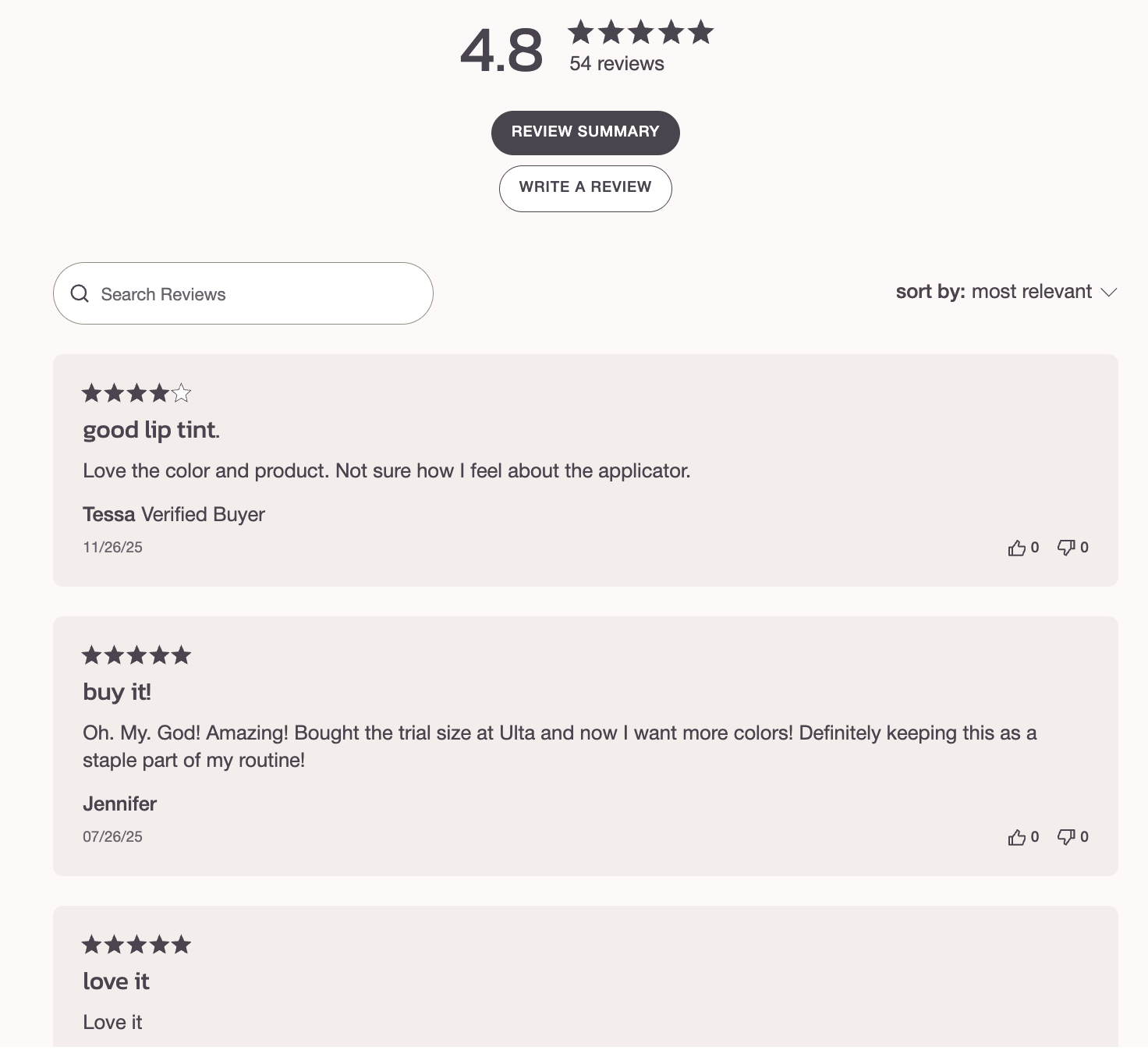
Insights from platforms such as Reviews.io show that AI-driven sentiment analysis enables models to go beyond star ratings and understand the reasons behind customer feelings. This understanding is a crucial input for generative recommendations.
How Review Patterns Affect GEO Visibility
From a GEO standpoint, review data influences visibility through interpretation logic:
- Repeated benefits reinforce PDP claims and reduce ambiguity
- Consistent sentiment increases recommendation confidence
- Contradictory or fragmented feedback introduces uncertainty
- Specific use-case language improves intent matching
- Detailed reviews tend to provide clearer signals for AI systems
In short, AI systems look for stability and alignment. When reviews consistently echo the same value propositions, models are more likely to recommend the product. When signals conflict, AI systems tend to avoid the risk.
Review Strategy Is Now a GEO Strategy
Customer reviews should be treated as structured product data instead of passive feedback. Reviews shape how AI systems interpret products at scale. Brands that encourage detailed, use-case-driven reviews create clearer training signals for LLMs. Those who ignore review quality or focus only on star ratings miss a critical GEO lever. How customers talk about your product matters just as much as how you describe it.
Authority Signals: How LLMs Evaluate Trust
While PDP content and reviews explain what a product is and how it performs, authority signals help AI systems answer a different question: Can this brand be trusted?
Examples of Authority Signals
Authority signals include:
- Third-party citations and press coverage
- Expert, clinical, or professional validation
- Industry awards and certifications
- Consistent brand mentions across credible sources
- The depth, quality, and consistency of a brand’s content footprint
Research such as Zoovu’s PDP analysis shows that authority signals vary by industry, but their role in trust-building is universal.
How Authority Influences AI Ranking Logic
Authority affects AI-generated recommendations through relationships such as:
- Higher authority reduces perceived risk
- External validation supports product claims
- Credible citations reinforce factual accuracy
- Strong authority can increase recommendation confidence
Generally, AI systems are inherently risk-averse. Authority lowers uncertainty and makes it easier for models to surface a brand as a safe recommendation.
What This Means for Brands
Authority gives AI systems and LLMs permission to recommend, and brands with strong authority signals are easier for AI engines to trust, reference, and include in generative answers. Without authority, even well-optimized PDPs may struggle to appear consistently in AI-driven discovery. In GEO, authority gives brands credibility at scale.
Strong PDPs vs. Weak PDPs in GEO
From a GEO perspective, the difference between strong and weak PDPs is structural.
| Area | Strong PDP | Weak PDP |
|---|---|---|
| Description | Clear, benefit-led, explanatory | Thin, generic, spec-heavy |
| Attributes | Complete and consistent | Missing or fragmented |
| Reviews | Pattern-rich, specific, verified | Sparse or uninformative |
| Authority signals | High, multi-source validation | Low or absent |
How To Act Now
The shift towards AI-driven discovery is underway, significantly impacting how products are displayed, summarized, and recommended. eCommerce brands that take action now, especially in competitive markets, will benefit the most, as AI-generated summaries can streamline the shopping process, replacing lengthy comparisons.
Recommended Action Plan
1. Audit PDP clarity, not just completeness
Evaluate whether each PDP clearly explains what the product does, who it’s for, and why it matters. Remove ambiguity before adding more content.
2. Standardize and enrich product attributes
Ensure attributes are complete, consistent, and aligned across PDPs, feeds, and supporting content. Structured data is the backbone of GEO.
3. Upgrade review strategy from volume to signal quality
Encourage reviews that mention use cases, outcomes, and real-world context. Treat reviews as inputs that train AI systems, not just conversion boosters.
4. Translate specs into benefits at scale
Technical details still matter, but they must be explained in human-readable language that AI systems can map to intent.
5. Invest in authority beyond owned channels
Build credible third-party validation through PR, expert mentions, and trusted coverage. Authority reduces risk in AI recommendations.
6. Align PDP optimization with GEO goals
PDPs should be optimized not only to rank and convert, but to be confidently summarized and recommended by AI engines.
Final Takeaway
AI systems are quickly becoming the layer between shoppers and storefronts. As that happens, the brands that win won’t be the ones with the longest PDPs or the most content. They’ll be the ones that are easiest to understand and trust.
Clear product explanations, consistent attributes, meaningful review patterns, and real authority all work together to reduce uncertainty for AI models. And when uncertainty drops, visibility rises. That’s the real shift behind GEO. This doesn’t replace SEO or conversion optimization. PDPs still need to rank and convert, but now they also need to teach AI systems how, when, and why to recommend a product. If that story isn’t clear, AI will simply move on to one that is.
If you’re unsure how your AI is interpreting your PDPs, that’s often the first sign it’s time to take a closer look. At Blue Wheel, we help eCommerce brands evaluate PDP clarity, review signals, and authority gaps through a GEO lens and turn those insights into practical, scalable improvements.
If GEO is becoming part of your organic roadmap, get in touch with our team of eCommerce SEO experts to learn how we can support your brand.
Anja Pendic
Anja Pendic is the Content Marketing Specialist at Blue Wheel, where she plays a key role in creating and managing content for the company’s website. With extensive experience in digital marketing, copywriting, and social media management, she crafts engaging blogs, case studies, and landing pages. Anja has worked across various platforms, including Amazon, Meta, and TikTok, delivering impactful content and strategies.