
GEO for eCommerce: How AI Search is Changing Product Discovery
Generative Engine Optimization (GEO) is the practice of optimizing eCommerce products and content, so AI-powered search engines can understand, trust, and recommend them to shoppers.
As tools like ChatGPT, Perplexity, and Google AI Overviews reshape how consumers research and buy, product discovery is shifting from keyword-based rankings to AI-generated recommendations. Ecommerce brands that fail to adapt risk becoming invisible in high-intent shopping moments, even if their SEO performance looks strong today. In 2026 and beyond, brands will win discovery by earning AI recommendations, not just search rankings.
What Is GEO (Generative Engine Optimization)?
Defining GEO for eCommerce
Generative Engine Optimization (GEO) is the process of optimizing brand, product, and content signals, so AI-powered search engines and large language models (LLMs) can confidently retrieve, interpret, and recommend eCommerce products.
A critical distinction is that AI systems do not evaluate individual pages in isolation. Lisa Wendland, Senior Director of Owned Media at Blue Wheel, recently joined the Keep Optimising Marketing Podcast, discussing The Four Steps to GEO Success. On the episode, Lisa explains, “AI isn’t about ranking pages, it’s really evaluating the brand as a whole, the trust signals and the clarity.”
GEO is therefore not about winning a single result. It is about making your entire brand easy for AI systems to understand and trust.
How GEO Differs From SEO
SEO focuses on crawlability, indexation, and ranking in traditional search engines. GEO focuses on interpretation, synthesis, and confidence in generative systems.
SEO asks, “Can Google rank this page?”
GEO asks, “Would an AI confidently recommend this product to a shopper?”
AI-powered search results often appear above traditional organic listings, meaning brands that are not optimized for AI summaries and overviews are effectively pushed further down the page or excluded entirely.
Why AI Search Depends on Natural Language Understanding
Large language models rely on semantic comprehension, not keyword matching. They look for clear explanations, contextual detail, and consistency across brand touchpoints.
AI search is increasingly about answering real-world questions like, “Is this the best option for a cold-weather getaway?” If a product description does not clearly explain use cases, benefits, and scenarios, it becomes difficult for an AI system to surface it confidently.
Who GEO Matters For
GEO is especially important for eCommerce brands with:
- Large or complex catalogs
- Multiple product variants
- Competitive or saturated categories
If an AI system cannot clearly interpret what a product is, who it is for, and why it is credible, it is unlikely to be recommended at all.
What GEO Really Means for Brands
Generative Engine Optimization is not about ranking higher. It’s about becoming eligible to answer specific consumer questions inside AI-led search and shopping experiences.
Unlike traditional search engines, AI agents do not scan a list of links and decide what to rank. They interpret intent, evaluate context, and then determine which products are trustworthy enough to recommend as part of a response. If a product does not clearly map to the question being asked, it is excluded entirely, even if it has strong SEO fundamentals.
For brands, this means optimization must shift from keyword coverage to question alignment. Product content, attributes, reviews, and FAQs need to explicitly connect what the product is to when and why it should be chosen. Visibility is no longer earned by being discoverable. It’s earned by being clearly relevant.
The Core Theme: AI Search Rewards Clarity, Completeness, and Trust
Across AI-driven shopping experiences, one theme is consistent. LLMs favor brands that are easy to understand, well-structured, and validated by external signals.
AI systems evaluate:
- How clearly the product information is presented
- Whether the data is structured and consistent
- If authority and credibility are confirmed elsewhere on the web
As Lisa Wendland emphasizes, “credibility is algorithmic.” AI engines weigh brand trust using signals across your site, reviews, PR coverage, and expert content.
The Three Pillars of GEO
Natural-language clarity enables LLM comprehension
Clear descriptions, benefits, and scenarios help AI understand what a product actually does and when it should be recommended.
Structured data enables machine readability
Organized attributes, specifications, FAQs, and schema allow AI systems to parse product information efficiently and accurately.
Reputation signals reinforce AI trust
Reviews, authoritative mentions, and expert validation help AI systems determine whether a product is safe and credible to recommend.
How AI Decides Which Products to Recommend
First-Party Data Strength
GEO-ready brands treat first-party data as an interconnected system, not isolated listings.
First-party data strength goes beyond having accurate PDPs. AI systems pull product understanding from structured feeds, synced platforms, and repeatable data pipelines.
This includes:
- PIMs that standardize attributes and taxonomy
- Google Merchant Center feeds that reinforce product clarity
- Marketplace listings that mirror core product truths
- Ongoing sync between owned and third-party platforms
When systems fall out of alignment, AI receives conflicting inputs. When feeds are clean, consistent, and structured, AI gains confidence in how, and when, to recommend a product.
How AI Builds Product Memory and Confidence
AI engines don’t treat products as static listings. They build a form of product memory over time, informed by how consistently a product is described, validated, and reinforced across the web.
When product data is aligned across PDPs, marketplaces, reviews, and third-party sources, AI gains confidence in how that product should be represented. When details conflict, such as variations in naming, attributes, or use cases, confidence drops. In those cases, AI is more likely to default to safer, better-defined alternatives.
This creates a compounding effect. Products that are clearly positioned early become easier for AI to recall and reuse in future responses. Products that delay GEO alignment have to work harder to earn trust later. Much like early SEO advantages, early clarity in AI ecosystems compounds.
Product Detail Pages (PDPs) as the Foundation of GEO
In GEO, PDPs act as structured knowledge hubs, not just conversion pages. They define a product as an entity that AI systems can reference when responding to shopper questions. Take the PDP page below, for example.
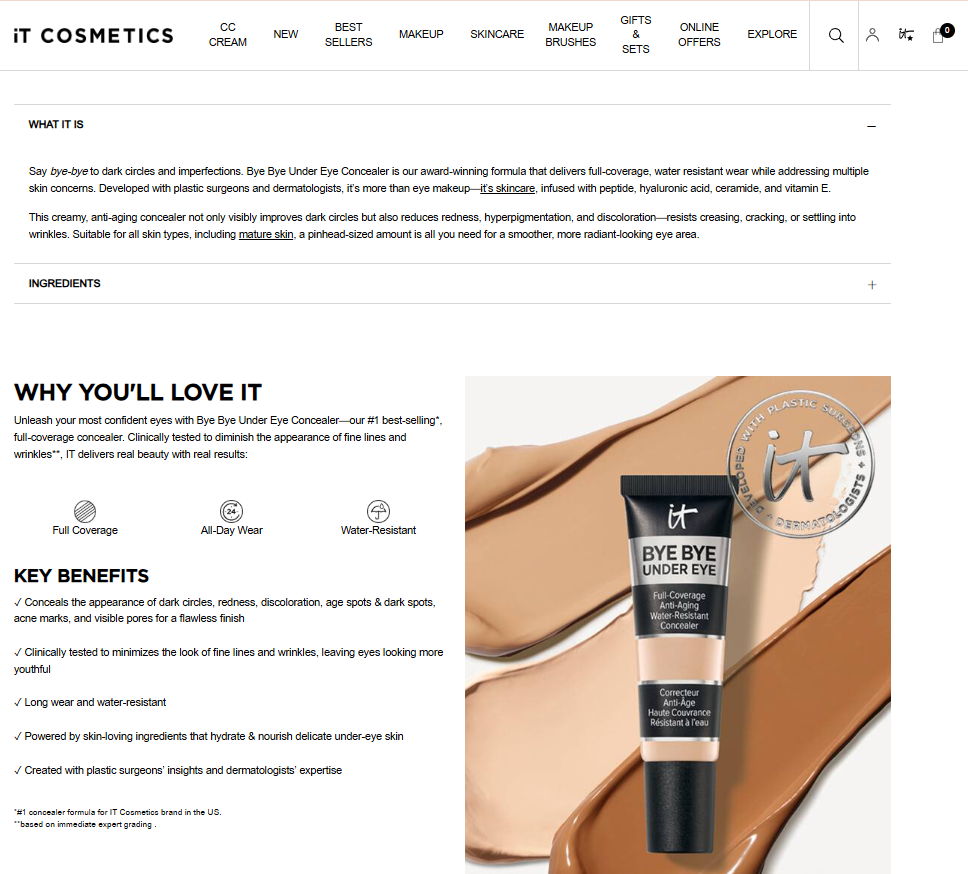
Source: itcosmetics.com PDP page
How LLMs Interpret PDPs
LLMs analyze PDPs to:
- Extract key attributes like size, material, compatibility, and pricing
- Understand primary benefits and intended use cases
- Map FAQs to real shopper intent
- Evaluate consistency across product variants and platforms
However, inconsistencies in product naming, categories, or attributes can depreciate trust. AI systems expect refined, curated product information that aligns across the site.
Why PDPs and FAQs Matter More Than Ever
In a GEO-driven environment, PDPs are no longer just conversion tools. They are training inputs.
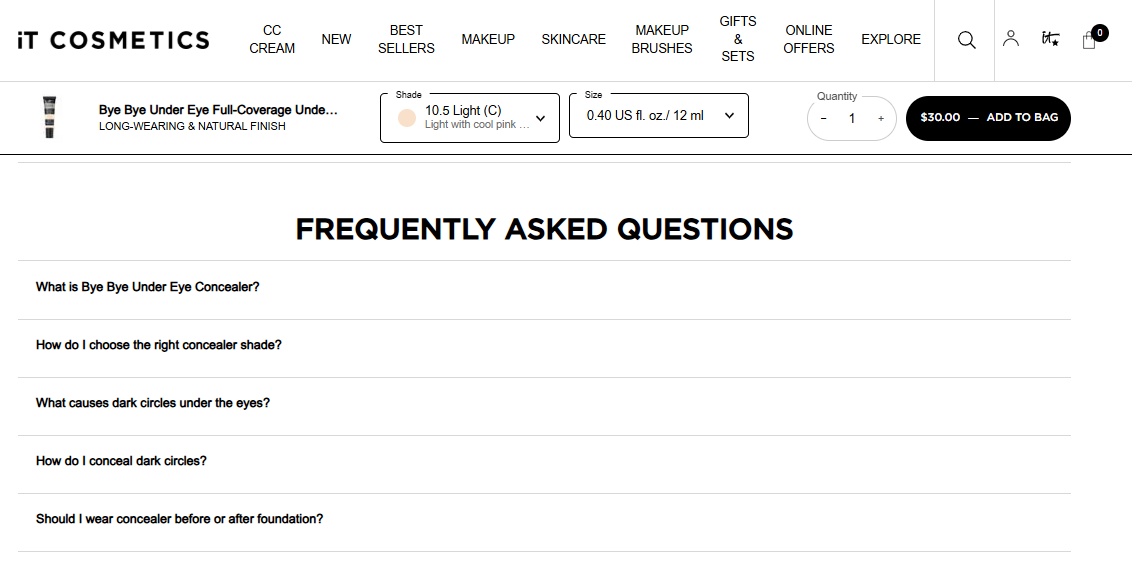
FAQs, in particular, play an outsized role. Well-structured FAQs help AI understand how real shoppers talk about a product, what concerns matter most, and where the product fits or does not fit. Questions such as “Is this good for…,” “How does this compare to…,” or “What should I know before using…” provide context that AI uses to generate accurate, confident responses.
Brands that treat FAQs as an afterthought risk leaving gaps in how AI interprets their products. Brands that use them strategically reduce ambiguity, improve recommendation accuracy, and increase the likelihood of being included in AI-generated answers.
What This Means for Brands
Strong PDPs increase AI confidence and inclusion. Thin, vague, or inconsistent PDPs reduce visibility in generative answers, even if those pages still rank well in traditional organic search.
Review Sentiment and Behavior Signals
What LLMs “See” in Reviews
LLMs do not read reviews individually. They analyze patterns such as:
- Review volume and recency
- Overall sentiment trends
- Repeated themes like quality, fit, durability, or customer service
How Reviews Influence AI-Generated Shopping Responses
AI systems use reviews to:
- Compare brands across a category
- Identify strengths and weaknesses at scale
- Assess trust and potential risk
Our POV: Why Review Governance Is Now a GEO Lever
Recurring complaints or unresolved issues do not get buried in AI search. They are summarized and surfaced. Brands that actively monitor, respond to, and learn from reviews improve both customer experience and AI trust.
Brand Authority and Trust Signals
What Are Authority Signals?
Authority signals are forms of validation that exist beyond your owned site, including press coverage, expert commentary, partnerships, and thought leadership.
How LLMs Use Trust Signals
AI systems evaluate authority by:
- Cross-referencing brand mentions across trusted sources
- Giving more weight to expert-backed content
- Using citations to validate product and brand claims
PR placements and authoritative backlinks play an increasing role in whether AI systems surface a brand or product.
What This Means for Brands
If your brand only exists on its own PDPs, AI systems have limited context. Authority-building content is now a foundational requirement for generative visibility.
GEO vs SEO: How Product Discovery Is Changing
SEO was built for ranking pages.
GEO is built for selecting products.
In the SEO era, success meant optimizing for keywords and earning backlinks. Discovery happened through lists of links, and shoppers compared options themselves.
In the GEO era, AI systems synthesize answers and recommend products directly. Instead of ranking pages, they evaluate whether a product can be clearly understood, trusted, and confidently suggested based on its data, reviews, and authority signals.
This is an evolution, not a replacement. SEO still matters, but it is no longer enough on its own.
Who Should Act Now
Ecommerce brands preparing for 2026 should:
- Audit PDP clarity, consistency, and completeness
- Standardize product attributes and naming conventions
- Add product-specific FAQs that reflect real customer questions
- Actively manage and respond to reviews
- Invest in expert-led, authoritative content and PR
- Treat AI visibility as a cross-functional effort across SEO, CX, product, and brand
The brands that treat generative AI as a new channel and move early will secure stronger long-term visibility.
Organizational Readiness: Aligning Teams for AI Visibility
GEO readiness is as much an organizational challenge as it is a technical one.
AI visibility doesn’t sit neatly within a single team. It requires coordination across SEO, product, CX, brand, and marketplace teams—each contributing signals AI systems evaluate.
Brands that move faster tend to have:
- Clear ownership of PDP standards and product data
- Defined processes for review monitoring and response
- Shared guidelines for how products are described across channels
- Alignment between brand storytelling and commerce execution
Without people and process alignment, even the best data and content strategies struggle to scale.
Ensure your brand and products are eligible and ready to be included in AI-generated recommendations. Use our checklist to quickly determine where your ecommerce brand stands with GEO.

Common GEO Gaps We See Across eCommerce Brands
Even brands investing heavily in SEO and media often struggle with GEO readiness. The most common gaps we see include:
- Fragmented product data systems: Product attributes live across PIMs, feeds, marketplaces, and internal tools, but aren’t fully aligned and create inconsistent signals for AI.
- PDPs optimized for conversion, not comprehension: Strong creative and CRO performance, but missing structured clarity around use cases, compatibility, and decision drivers that AI relies on.
- Reactive review management: Reviews are monitored for damage control, not actively analyzed for recurring themes that influence AI trust and recommendation logic.
- Limited off-site authority signals: Brands focus on owned channels but lack expert-backed content, citations, or third-party validation that AI systems use to corroborate claims.
- No clear ownership of AI visibility: GEO falls between teams such as SEO, product, CX, and brand, without a shared framework or accountability.
These gaps don’t just limit visibility. They make it harder for AI systems to confidently recommend a product at all and for many brands, GEO readiness isn’t about starting from scratch, but instead, it’s about identifying where systems, signals, and teams are misaligned.
Final Takeaway
GEO is about earning recommendations, not ranking. Ecommerce brands that win in AI-driven discovery will be the ones that make their products easy to understand, easy to trust, and consistently validated across the web.
At Blue Wheel, we view GEO as a cross-channel discipline, not a standalone tactic. AI systems do not differentiate between your website, a marketplace listing, or a third-party mention. They merge everything into a single understanding of your brand and products.
That’s why GEO success depends on consistency across content, commerce, and validation signals. Brands that coordinate PDP optimization, review strategy, data hygiene, and authority-building are better positioned to earn AI trust. GEO is not about chasing algorithms. It’s about making your products easy for machines to understand and easy for consumers to choose.
Blue Wheel is a full-service marketplace agency with over 10 years of Amazon experience. Reach out to the team today to learn how we can help your brand prepare for GEO and the future of eCommerce discovery.

Lauren Palmisano
Lauren Palmisano is the Marketing Manager at Blue Wheel, where she manages all aspects of the company’s content marketing strategy. From overseeing the content calendar to managing blog and case study creation, website maintenance, and running Blue Wheel’s LinkedIn page, Lauren plays a pivotal role in driving the brand’s digital presence. With a career that started in eCommerce event management before transitioning into eCommerce marketing, Lauren brings a well-rounded approach to delivering impactful content and experiences that resonates with audiences.