
Amazon’s COSMO algorithm (Common Sense Knowledge Generation) marks a major evolution in how products are discovered and ranked. Instead of relying primarily on keyword matching, COSMO interprets shopper intent, evaluates contextual signals, and prioritizes products that deliver strong customer outcomes.
What brands need to know:
- Amazon search is shifting from keywords to intent-driven discovery
- Product relevance and performance signals matter more than ever
- Strong PDP content and customer experience directly influence visibility
- COSMO impacts organic discovery today, while conversational AI adoption continues to grow
- Brands that invest in clarity, storytelling, and cross-channel consistency will be better positioned for future growth
COSMO is not a short-term ranking tweak. It is a structural shift toward AI-driven commerce discovery.
Introduction to COSMO: Amazon’s AI-Driven Search Algorithm
Consumers are becoming increasingly comfortable interacting with AI chat interfaces like ChatGPT, Claude, and Gemini. As conversational search habits evolve, those behaviors are beginning to influence how shoppers explore products on Amazon, helping fuel the adoption of experiences like Rufus. At the same time, Amazon has long prioritized relevance over keyword density, with policies designed to discourage keyword stuffing and other manipulative tactics. COSMO represents Amazon’s continued evolution toward a search ecosystem that better interprets intent and rewards true product relevance at scale.
What Is COSMO? A Smarter Engine for Product Discovery
COSMO is Amazon’s next-generation search and ranking system, powered by machine learning and large-scale knowledge modeling. Rather than relying solely on exact keyword matches, COSMO evaluates meaning, context, and shopper behavior to surface the most relevant products.
At its core, COSMO helps Amazon interpret what a shopper is trying to accomplish rather than simply matching the words they typed.
Importantly, COSMO does not replace Amazon’s longstanding search infrastructure. Many experts believe Amazon’s A9 engine continues to operate beneath the surface as a retrieval layer, helping identify candidate results, while COSMO enhances ranking and relevance through intent interpretation and behavioral signals. In practice, this means keywords still matter for certain queries and retrieval scenarios, even as Amazon becomes better at understanding meaning and context.
What makes COSMO different:
Intent over keywords: COSMO interprets shopper intent, allowing relevant products to surface even when exact phrasing differs.
Multi-signal relevance: It evaluates millions of behavioral, contextual, and performance signals to determine which products best satisfy the query.
Together, these capabilities transform Amazon search from a static keyword engine into an adaptive discovery system that rewards true relevance.
Rufus vs. COSMO: What Brands Need to Know
Rufus and COSMO are often discussed together, but they serve different roles in Amazon’s AI ecosystem.
COSMO = the discovery engine
COSMO influences how products are ranked and surfaced by interpreting intent and performance signals.
Rufus = the shopper interface
Rufus is the conversational shopping experience customers may use to ask questions and explore products.
What we’re seeing right now
• COSMO is influencing discovery and relevance today
• Rufus adoption is growing, but conversational prompts are not yet dominant across categories
• Amazon best practices still apply. Brands should not remove keywords or rewrite titles from scratch
• Keywords still play a role in retrieval and certain query types
• Legacy listings built on keyword stacking are most at risk
The foundation for both remains the same: strong PDP clarity and performance signals. Whether a shopper types a search or asks a question, Amazon relies on product page relevance to determine visibility.
While Rufus is the visible change, COSMO represents the structural evolution happening behind the scenes. As Amazon’s AI ecosystem continues to mature, brands should expect ongoing refinement and remain adaptable as new insights emerge. For a deeper look at conversational shopping and AI-driven discovery, explore our Amazon Rufus guide.
Want to understand how AI is reshaping discovery and conversion? Check out our webinar:The Future of Amazon Growth: How AI Is Reshaping Discovery, Media, and Conversion.
How COSMO Works
While COSMO is powered by sophisticated AI, its core functions can be understood through four key mechanisms.
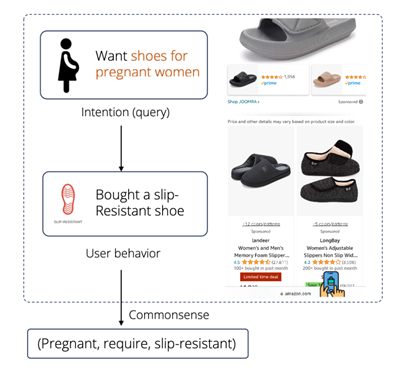
Intent and Semantic Understanding
COSMO analyzes the meaning behind search queries to understand what shoppers truly want.
Think of it like a sales associate who knows that “office chair for back pain” is about ergonomic support, not just seating.
Behavioral and Contextual Signals
Real-time shopper behavior influences rankings.
Signals include:
- Click behavior and dwell time
- Purchase patterns
- Search refinements
- Device and shopping context
Results adapt dynamically based on how shoppers interact with listings.
Product Relevance and Performance
COSMO evaluates how well a product satisfies intent, not just keyword presence.
Key signals may include:
- Conversion performance
- Review sentiment and ratings
- Content clarity and completeness
- Image quality and PDP experience
Continuous Learning
COSMO continuously improves using outcome-based learning.
If shoppers consistently choose certain products for a query, the system learns and refines future rankings.
In simple terms: COSMO gets smarter with every search and purchase.
Why COSMO Matters for Brands
COSMO reshapes how products gain visibility and compete on Amazon.
Better visibility for relevant products
Listings that genuinely match shopper intent can surface more often, even in crowded categories.
Increased conversion potential
More relevant traffic leads to higher engagement and stronger conversion rates.
Shifted shopper expectations
Customers expect intuitive discovery and fast decision-making experiences.
Competitive differentiation
Brands that invest in high-quality content and customer experience gain an advantage.
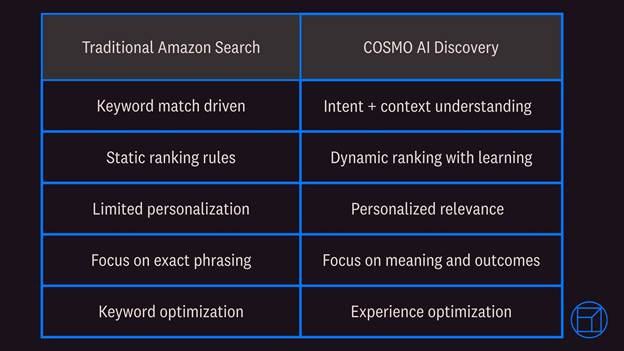
COSMO vs. Traditional Keyword-Based Search
Amazon discovery is evolving from search mechanics to shopper relevance.
Beyond the PDP: Signals That Influence AI-Driven Discovery
Amazon discovery is no longer confined to the product detail page. As its AI capabilities evolve, systems like Rufus can incorporate information beyond Amazon listings when helping shoppers evaluate products.
For example, broader queries such as “What are the top ten [product type] for 2026?” may trigger Rufus to search the web, surface external sources, and cite those references within its response. This indicates that AI-driven discovery can draw on information outside the PDP to help shoppers compare options and make decisions.
For brands, this expands the relevance landscape. In addition to strong PDP content, discovery may be influenced by:
- credible review coverage and expert roundups
- consistent product information across digital properties
- brand authority and trust signals
- clear use-case and benefit communication across channels
As AI-assisted shopping evolves, visibility is increasingly shaped by the broader information ecosystem surrounding a product, not just the listing itself.
What COSMO Signals About the Future of eCommerce Search
From a Blue Wheel perspective, COSMO is not a temporary ranking update. It signals a structural shift in how digital commerce discovery works.
COSMO amplifies what Amazon has always rewarded.
Relevance has long mattered more than keyword stuffing. COSMO increases the importance of intent and customer outcomes. Brands should not abandon keywords, but legacy keyword-heavy content strategies are losing effectiveness (if they were ever effective to begin with).
Rufus is real, but shopper behavior is still evolving.
Conversational discovery is growing, yet not dominant across categories. The immediate priority is building relevance and clarity, so products surface wherever discovery begins.
PDP and advertising performance are increasingly interdependent.
Amazon relies on PDP signals to determine relevance, which influences ad delivery and performance. Strong retail media outcomes depend on strong product page foundations and ads drive sales velocity, which influences organic ranking.
Amazon continues to close loopholes that enable gaming.
Platform changes consistently reward quality experiences over tactical manipulation.
Discovery is expanding beyond Amazon.
AI-driven discovery may incorporate signals from broader digital ecosystems, reinforcing the importance of consistent brand content and trusted information sources.
This is a brand marketer’s moment.
As AI gets better at interpreting intent, storytelling, clarity, and customer-first content become competitive advantages rather than creative extras.
COSMO is not a reason to panic, but it is a reason to modernize.
Positioning for the AI-Driven Marketplace
Amazon’s COSMO algorithm reflects a broader shift toward AI-powered discovery, intent understanding, and experience-driven relevance. Brands that prioritize clarity, performance, and customer experience will be better positioned as AI-led discovery accelerates.
Understanding how AI evaluates relevance today will help brands compete more effectively tomorrow.
To learn how AI is reshaping Amazon discovery, media, and conversion, check out our webinar on this topic:The Future of Amazon Growth: How AI Is Reshaping Discovery, Media, and Conversion.


Lauren Palmisano
Lauren Palmisano is the Marketing Manager at Blue Wheel, where she manages all aspects of the company’s content marketing strategy. From overseeing the content calendar to managing blog and case study creation, website maintenance, and running Blue Wheel’s LinkedIn page, Lauren plays a pivotal role in driving the brand’s digital presence. With a career that started in eCommerce event management before transitioning into eCommerce marketing, Lauren brings a well-rounded approach to delivering impactful content and experiences that resonates with audiences.