
Prime Day has always offered brands a performance benchmark but this year it also provided a clearer view of how Amazon shopping and advertising are shifting.
Shoppers browsed less, responded more strongly to meaningful offers, and made more intentional purchase decisions. At the same time, advertising performance increasingly depended on connected media, deliberate pacing, and the ability to adapt throughout the event.
Across Blue Wheel’s portfolio, we saw ad spend remain relatively steady while revenue, orders, ROAS, and engagement increased year over year. Those gains may be a reflection of several broader shifts brands should consider as they prepare for Prime Big Deal Days, Cyber Week, and the remainder of Q4.
Prime Day shoppers became more intentional
While we saw fewer product views in 2026, the decline in revenue was much smaller and conversion rates improved. While at first glance those metrics suggest a more focused audience, another shift may also be influencing how shoppers move through the purchase journey.
Across Blue Wheel's client portfolio, activity within Alexa for Shopping (formerly Rufus) accelerated dramatically during Prime Day. Sponsored prompt usage increased significantly compared to the weeks leading up to Prime Day, AI-generated product recommendations surged, and purchases attributed to AI prompts also increased.
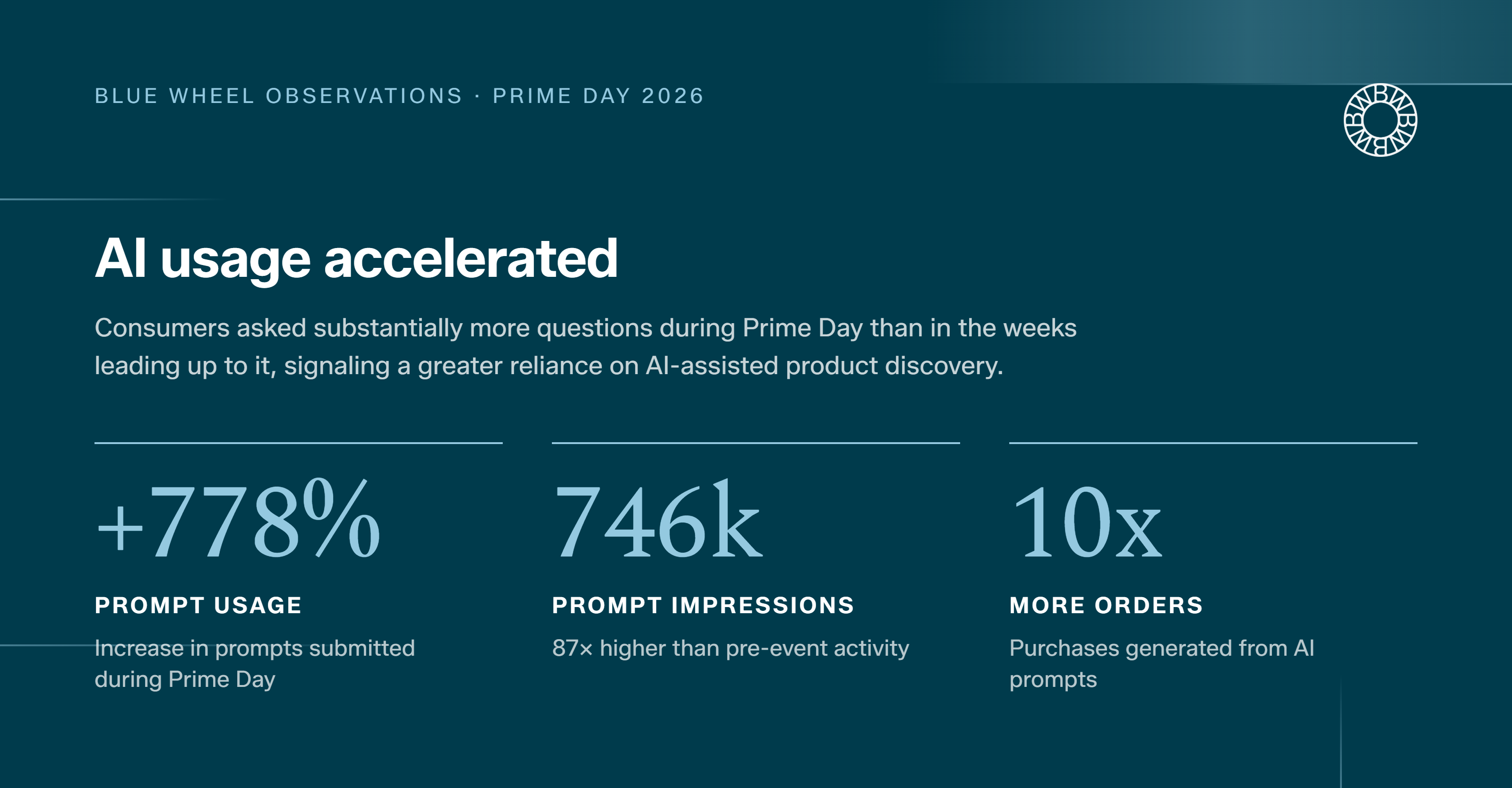
Taken together, these trends suggest that shoppers may be completing more of their research through conversational AI before ever clicking into a product detail page. Instead of manually comparing dozens of listings, consumers are increasingly asking AI to recommend products, explain differences, compare options, and validate their purchasing decisions.
That shift could help explain why we saw fewer overall product views while shoppers who did reach product pages appeared more prepared to buy. AI is beginning to compress the traditional research phase, helping shoppers narrow their choices before they even reach a PDP.
For brands, this changes the objective. Success is no longer just about attracting clicks, but rather about ensuring your products are the ones AI systems are confidently recommending to shoppers. That means investing in rich product content, clearly communicating differentiators, highlighting use cases, and building PDPs that answer the questions shoppers are increasingly asking conversationally.
Sufficient investment still required greater efficiency
Prime Day remains an important growth opportunity, and brands need sufficient budgets to compete. But larger investment works best when paired with tighter execution.
Across Blue Wheel’s portfolio, spend increased modestly while ad revenue and orders grew by significantly larger percentages. ROAS improved, CPC declined, and CTR increased well ahead of the broader industry benchmarks. Impressions were lower, but the traffic generated was more engaged.
Incremental budget should be directed toward the products, audiences, channels, and event moments most likely to produce growth.
That distinction will become even more important during Q4. Cyber Week is crowded, costs rise quickly, and consumer attention is fragmented across Amazon, retail media, social platforms, search, email, and creator content. Brands need enough investment to remain competitive, but they also need the flexibility to reallocate that investment as shopper behavior changes.
Amazon’s advertising ecosystem is becoming more connected
One of the clearest shifts in 2026 was the increased role of Amazon DSP.
Industry-wide, DSP represented a larger portion of Prime Day investment than it did the previous year. Blue Wheel’s portfolio followed the same direction, with DSP’s share of spend nearly tripling year over year. Sponsored Ads still represented the majority of investment, but both channels became more efficient at the same time.
This is important because DSP and Sponsored Ads play different but complementary roles.
Sponsored Ads help capture active shopper intent within Amazon. DSP expands the audience strategy through broader reach, retargeting, and re-engagement. During a longer shopping event, those capabilities can help brands remain visible as customers move from initial discovery to consideration and eventual purchase.
Blue Wheel’s results also showed that DSP generated a meaningful share of revenue relative to its portion of spend. Internal observations indicated that re-engaging shoppers who interacted earlier during Prime Day contributed to stronger final-day performance.
The broader lesson is that brands should no longer treat Amazon media as a collection of isolated campaign types. Sponsored Ads, DSP, promotional strategy, product content, and audience data increasingly need to function as one system.
That connected approach also prepares brands for Amazon’s continued expansion into AI-assisted shopping. While the available results do not yet prove the full effect of Alexa for Shopping or other AI experiences on Prime Day performance, Amazon’s direction is clear – product discovery is becoming more personalized and signal-driven. Brands with stronger content, audience strategies, reviews, promotions, and media engagement will be better positioned within that environment.

Prime Day became a multi-day customer journey
The four-day event also showed that shopper behavior was not consistent from one day to the next.
Blue Wheel’s internal observations found particularly strong click-through activity earlier in the event, when shoppers were discovering products and evaluating deals. Later in the event, click-through rates softened while conversion strengthened. Day 4 ultimately became an important performance opportunity, supported by both new demand and shoppers returning after earlier interactions.
This pattern challenges the idea that brands should divide budgets evenly across every event day.
Blue Wheel entered Prime Day with a more deliberate pacing plan, increasing investment on the stronger bookend days and pulling back on the softer third day. Revenue still grew year over year each day, even as spend moved in different directions.
The practical implication is that Prime Day planning needs to reflect the customer journey:
- Early investment can support discovery, traffic, and audience building.
- Mid-event performance should guide real-time budget decisions.
- Later investment can capture returning shoppers and reinforce urgency before deals end.
For Prime Big Deal Days and Cyber Week, brands should build day-by-day and hour-by-hour pacing scenarios before campaigns begin. Those plans should flexible and real-time data should determine where additional budget can create the most value.
Prime Day success started before the event
Some of the strongest Prime Day strategies extended beyond the official event window.
Lead-in promotions helped brands create awareness and convert shoppers before the event began. Lead-out offers captured customers who continued shopping afterward. In some cases, brands generated stronger results in the surrounding weeks than during Prime Day itself.
Off-Amazon demand generation also remained an underused opportunity. Social media, social commerce, influencers, email, and DTC audiences can all help bring qualified traffic to Amazon when paired with an active promotion.
This matters because Prime Day is no longer a self-contained marketplace event. Shoppers may first hear about a product through a creator, research it through search or social, compare options on Amazon, and return later through a retargeting message or personalized recommendation.
Brands preparing for Q4 should therefore connect their Amazon strategy with the rest of their marketing calendar. Promotional timing, creator content, paid social, search, email, and retail media should reinforce the same priority products and messages.
What brands should carry into Prime Big Deal Days and Cyber Week
Prime Day 2026 offered several clear planning priorities for the next major shopping events.
First, brands should identify the hero products most capable of attracting both existing demand and new shoppers. Those products need competitive offers, strong inventory positions, and content built to answer the questions customers are likely to ask.
Second, media investment should grow alongside the ability to optimize it. Brands should enter Q4 with clear pacing rules, channel roles, performance thresholds, and room to shift budget toward emerging opportunities.
Third, DSP should be considered part of the core Amazon media plan, particularly for reaching, retargeting, and re-engaging shoppers across a longer decision journey.
Finally, brands should plan beyond the dates printed on the promotional calendar. Demand building begins before the event, and the halo can continue afterward through remarketing, repeat purchases, branded search, and renewed engagement with products discovered during the promotion.
Conclusion
Prime Day 2026 wasn't simply a preview of Q4. It was one of the clearest signals yet that AI is becoming part of the purchase journey. As conversational shopping continues to reshape how consumers discover, compare, and evaluate products, brands will need to optimize for more than search rankings alone. The brands that succeed in Prime Big Deal Days and Cyber Week will be those that create the content, media strategies, and customer experiences that both shoppers and AI systems can confidently trust and recommend.
Preparing for Prime Big Deal Days or planning your Q4 strategy? Connect with the Blue Wheel team to explore how a more connected approach to commerce can help your brand capitalize on the opportunities ahead.

Lauren Palmisano
Lauren Palmisano is the Marketing Manager at Blue Wheel, where she manages all aspects of the company’s content marketing strategy. From overseeing the content calendar to managing blog and case study creation, website maintenance, and running Blue Wheel’s LinkedIn page, Lauren plays a pivotal role in driving the brand’s digital presence. With a career that started in eCommerce event management before transitioning into eCommerce marketing, Lauren brings a well-rounded approach to delivering impactful content and experiences that resonates with audiences.