
Retail readiness has long been a foundational concept in eCommerce. Before investing in advertising or driving traffic to a product, brands needed to make sure the basics were in place: accurate product information, compelling content, competitive pricing, strong reviews, available inventory, reliable fulfillment, and an optimized product detail page.
While those fundamentals are still in place, in the age of AI, they carry even more weight. The difference now is where and how shoppers are making decisions.
Product discovery is happening more and more often through AI-powered search, conversational shopping assistants, retail algorithms, social platforms, and external LLMs. Shoppers can ask a question, compare products, narrow their options, and arrive at a product detail page with much of their research already complete.
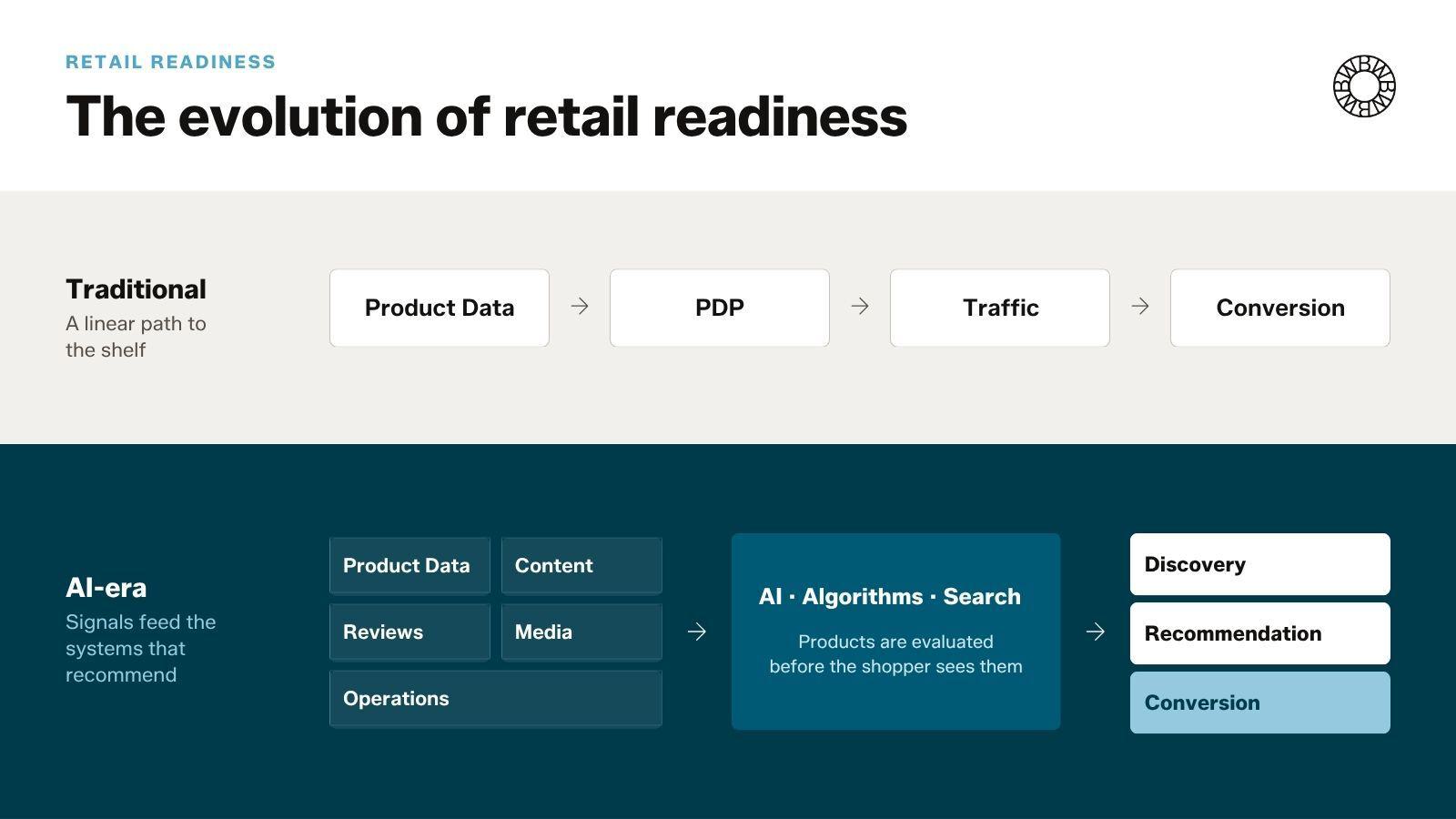
At the same time, the systems powering these experiences are evaluating products before the shopper does. They are interpreting product data, content, reviews, pricing, availability, brand signals, and other information to determine what is relevant to a shopper's request.
Retail readiness can no longer simply begin at the product detail page. In today’s eCommerce landscape, being retail ready today means making your brand discoverable, understandable, recommendable, purchasable, and measurable all across the entire commerce ecosystem.
What Retail Readiness Used to Mean
The traditional retail readiness playbook focused heavily on the digital shelf.
Before putting meaningful advertising dollars behind a product, brands were expected to have the core elements in place: sufficient inventory, accurate product data, optimized titles and bullets, high-quality imagery, A+ Content, strong ratings and reviews, competitive pricing, and a reliable fulfillment strategy.
That logic still remains today – driving traffic toward an incomplete or poorly optimized product experience wastes media dollars and in turn creates unnecessary friction.
But the traditional model was built around a relatively straightforward assumption that a shopper searches, clicks a listing, evaluates the product page, and decides whether to buy. But that journey has become more complex because AI is beginning to participate in the evaluation itself.
AI Is Moving Product Discovery Upstream
Consider how a shopper might research a product today.
Instead of searching "best moisturizer" and opening eight product pages, they might ask:
What is the best moisturizer for dry, sensitive skin that won't feel greasy under makeup?
Someone shopping for running shoes could ask:
What are the best running shoe options for wide feet?
And from there end up comparing arch support, price, reviews, and intended use in the same conversation. These are very different discovery behaviors from traditional keyword search.
Amazon is already bringing this behavior directly into the marketplace. Sponsored Products prompts and Sponsored Brands prompts can appear in shopping results and on product detail pages, giving shoppers AI-generated opportunities to explore relevant product information. Amazon says these experiences use first-party signals from detail pages, Brand Stores, campaign data, and other sources to provide contextual information during the purchase journey.
Many brands do not realize just how significant these implications are. The PDP still matters enormously, but it is increasingly doing two jobs. It needs to persuade the shopper who reaches the page while also supplying information to the systems helping that shopper decide what deserves consideration in the first place.
Your products need to make sense to machines and people
Traditional eCommerce optimization has often focused on keywords but AI introduces yet another layer – intent and context.
AI systems need enough information to understand what a product is, who it is for, which problems it solves, how it differs from alternatives, and when it might be relevant.
This expands the definition of an optimized product experience.
Retail readiness now starts with the quality of the signals surrounding the product.
The Five Pillars of Retail Readiness in the Age of AI
The fundamentals of retail readiness still provide the foundation, but how those fundamentals connect across the customer journey is changing rapidly.
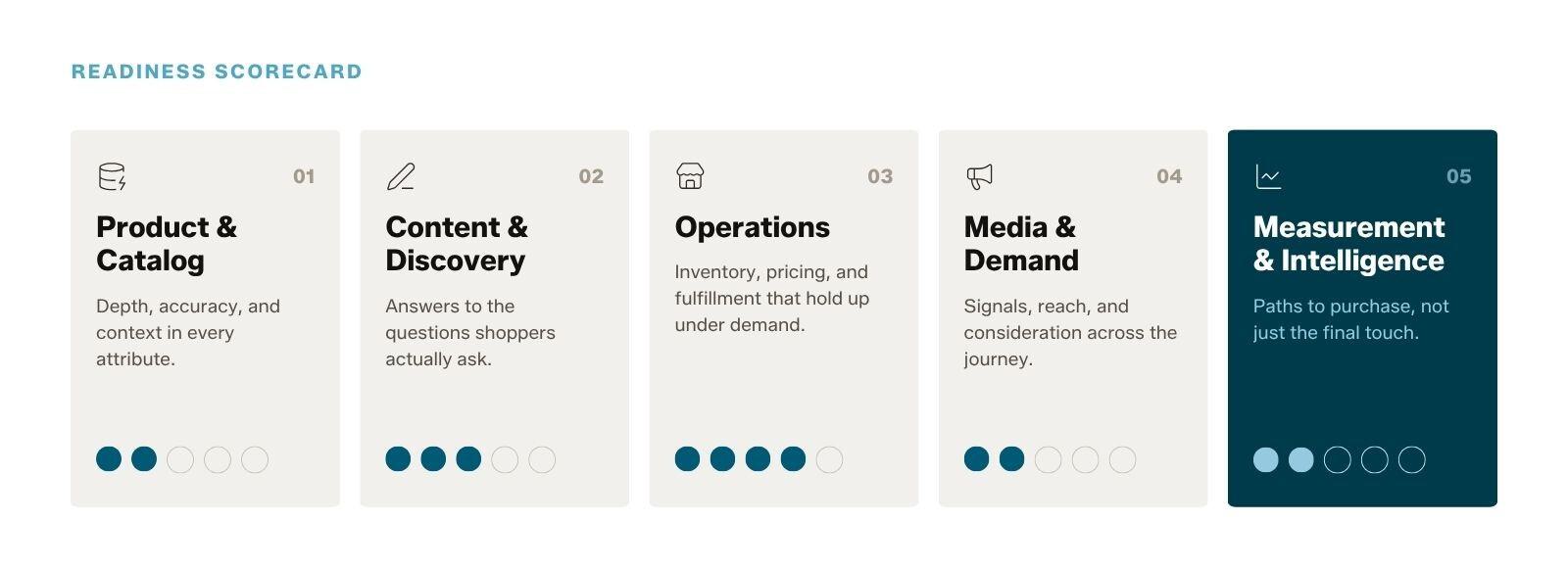
For brands evaluating their readiness today, five areas deserve particular attention.
1. Product and Catalog Readiness
While product data has always mattered to marketplaces, AI makes the depth, accuracy, and consistency of that information even more important.
Titles, descriptions, specifications, attributes, ingredients, materials, sizing, compatibility, variations, pricing, and availability all help commerce platforms understand what a product is.
However, now, product information also needs to provide context.
Imagine a skincare product with a listing clearly stating that it contains ceramides and hyaluronic acid. Those attributes are useful, but a richer product experience might also explain the skin types it is designed for, where it fits within a routine, the concerns it addresses, how it feels when applied, and what differentiates it from another moisturizer in the same portfolio.
That context helps human shoppers make decisions and also gives AI systems more meaningful information to work with when interpreting shopper intent. Including that information can help your product be recommended by AI.
Mirakl's research into agentic commerce makes a similar distinction, identifying clean product data and context-rich descriptions as key elements of AI commerce readiness.
The question brands should be asking is no longer simply, "Is our catalog complete?"
It is also, "Does our catalog provide enough information to understand when and why our products should be recommended?"
2. Content and Discovery Readiness
Once the product data foundation is in place, brands need to think more broadly about the content surrounding it.
Shoppers rarely make decisions based on specifications alone. They want answers to their questions about the product:
Is this product right for me? How is it different? Will it work with something I already own? What do people like about it? What problems does it solve?
Those questions increasingly resemble the prompts shoppers enter into AI assistants.
Brands should therefore evaluate PDP copy, A+ Content, Brand Stores, FAQs, imagery, video, reviews, educational content, category pages, and their owned website as parts of a connected information ecosystem.
The goal is not to stuff every conceivable question onto a PDP. It is to build enough high-quality, consistent context around the product that shoppers and discovery systems can understand it confidently.
This is also where retail readiness begins to overlap with Generative Engine Optimization, or GEO.
Search visibility increasingly depends on more than matching a keyword. Brands need content that demonstrates relevance, authority, specificity, and consistency across the places AI systems may use to understand them.
Strong retail content therefore supports more than conversion – it supports discovery before the click.
3. Operational Readiness
AI-powered discovery does not change the fundamental reality of commerce that the product still has to be available and easy to buy.
Inventory health, competitive pricing, Buy Box ownership, fulfillment speed, catalog accuracy, ratings, reviews, returns, and suppression issues remain central to retail performance.
Their role, however, is becoming broader.
A product may have outstanding content and strong demand, but persistent inventory issues or inaccurate pricing create friction between discovery and purchase. As commerce becomes more automated, maintaining accurate and current information across channels becomes increasingly important. AI readiness therefore isn't purely a content or technology initiative, but it also depends on operational reliability.
The brands best positioned for AI-powered commerce will be able to connect the information describing their products with the systems responsible for actually delivering them.
4. Media and Demand Readiness
Media also needs a place in the modern definition of retail readiness.
Historically, retail readiness was often treated as the prerequisite to advertising. Optimize the listing first, then turn on media.
That sequencing still makes sense, but the relationship between media and retail is becoming much more interconnected.
Amazon offers a clear example. Sponsored Products and Sponsored Brands prompts use signals from product detail pages, Brand Stores, campaign data, and other Amazon sources to create AI-powered conversational advertising experiences. Amazon reports that nearly 20% of shoppers who interact with a prompt continue the conversation about the brand, while adding prompts to a Sponsored Brands ad has driven a 6% increase in conversions.
Amazon has also introduced AI-powered Sponsored Brands collections that can dynamically choose products from an advertiser's catalog based on campaign targets and shopping signals. The quality of the underlying retail signals increasingly affects what AI-powered media has to work with.
Meanwhile, media creates signals of its own. Sponsored Ads, Amazon DSP, streaming TV, paid social, paid search, creator marketing, and other channels build awareness and influence consideration well before the final conversion, which makes media part of the readiness equation.
Brands need to understand whether their retail foundation can support demand and whether their media strategy is creating the signals, reach, and consideration needed to compete throughout the customer journey.
5. Measurement and Intelligence Readiness
The final pillar may be argued as one of the most important pieces of retail readiness in today’s commerce. If discovery behavior changes, measurement needs to change with it.
Traditional eCommerce reporting often relies heavily on traffic, clicks, conversion rates, and last-touch attribution. Those metrics remain useful, but they may not capture the entire journey when AI, media, creators, and multiple commerce surfaces contribute to a purchase.
A shopper might encounter a creator video, see an Amazon DSP ad, research the category with an AI assistant, compare several products through Amazon's shopping tools, visit a PDP, leave, and return later through branded search.
Which interaction drove the sale? Well, there may not be just one single answer.
Brands need measurement frameworks that help them understand paths to purchase rather than simply the final touchpoint.
On Amazon, AMC can provide deeper visibility into media exposure, new-to-brand behavior, audience overlap, conversion paths, and the interactions occurring before purchase. Amazon has also introduced reporting for Sponsored Products and Sponsored Brands prompts, giving advertisers visibility into prompt-level impressions, clicks, orders, spend, sales, ACOS, and ROAS.

Beyond Amazon, brands should begin connecting traditional eCommerce performance with AI visibility, branded search behavior, marketplace performance, media exposure, and cross-channel signals.
The objective isn't to replace existing KPIs but instead to build a more complete picture of how customers discover and choose products.
AI Makes the Fundamentals More Important
It is tempting to treat AI readiness as another technology initiative while in reality, many of the biggest opportunities start with fundamentals brands already control.
Incomplete attributes create gaps when AI tries to understand a product and thin PDP content provides fewer answers when shoppers ask detailed questions. Inconsistent product information creates confusion across discovery surfaces. Poor reviews provide less evidence for shoppers and the systems synthesizing customer sentiment. Inventory problems interrupt the journey after demand has already been created and disconnected media and measurement make it harder to understand what is actually influencing growth.
AI raises the standard for retail readiness because more systems are relying on the same underlying commerce signals.
The opportunity is to make those signals stronger and more connected.
Retail Readiness Is Becoming Channel-Agnostic
The other major shift is where retail readiness begins and ends.
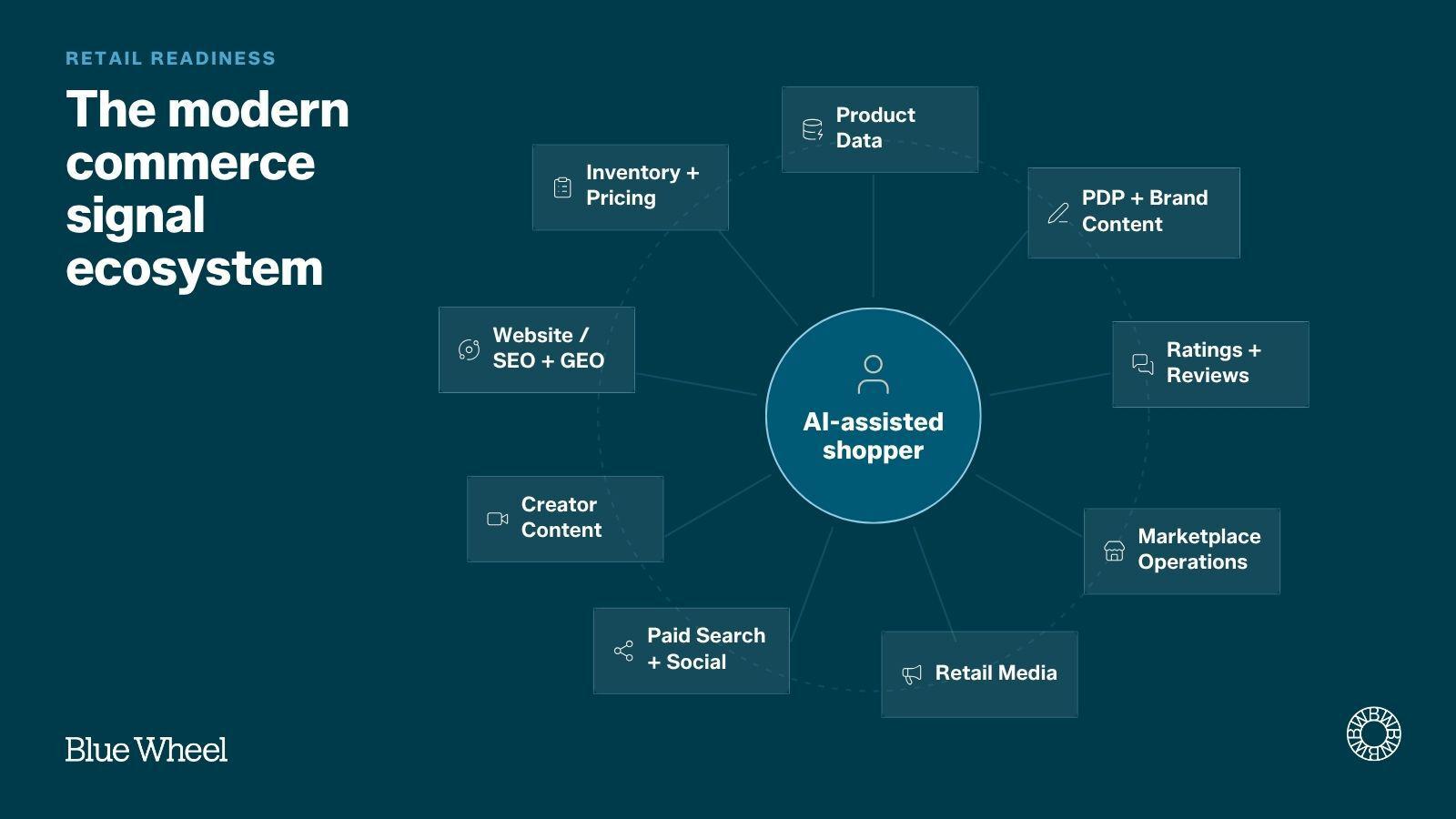
Commerce journeys no longer stay neatly within individual channels. A shopper might discover a product through TikTok, research the category through ChatGPT, visit the brand's website, compare reviews on Amazon, encounter an Amazon DSP ad, and ultimately purchase through a marketplace or the brand's DTC site. Each interaction contributes information, intent, or influence to the journey.
That makes it increasingly difficult to separate "Amazon readiness," "DTC readiness," "social readiness," and "AI readiness" into completely independent strategies.
The stronger approach is to build a commerce foundation capable of supporting all of them.
Product data needs to be consistent. Content needs to answer real shopper questions. Marketplace operations need to support demand. Media needs to connect discovery with consideration. Measurement needs to follow the customer across those interactions.
Retail readiness is quickly morphing into becoming commerce readiness.
How Retail Ready Is Your Brand?
Retail readiness used to answer a relatively simple question: Is this product ready for traffic?
Today, brands need to answer a much broader one:
Is our commerce ecosystem ready to be discovered, understood, recommended, purchased, and measured wherever the customer journey begins?
That question touches product data, content, operations, media, measurement, and the connections between them.
AI-powered commerce will continue to evolve, and new discovery surfaces will emerge. Marketplaces will introduce new advertising and shopping experiences, so shopper behavior is bound to keep changing with them. The brands positioned to adapt will be the ones with a strong enough commerce foundation to evolve alongside those changes.
Want to assess how retail ready your brand is in the age of AI? Reach out to the team, we would be happy to chat.

Lauren Palmisano
Lauren Palmisano is the Marketing Manager at Blue Wheel, where she manages all aspects of the company’s content marketing strategy. From overseeing the content calendar to managing blog and case study creation, website maintenance, and running Blue Wheel’s LinkedIn page, Lauren plays a pivotal role in driving the brand’s digital presence. With a career that started in eCommerce event management before transitioning into eCommerce marketing, Lauren brings a well-rounded approach to delivering impactful content and experiences that resonates with audiences.