
This year's announcements went well beyond bolting new AI features onto existing tools. Amazon laid out a more connected approach to media buying, campaign creation, optimization, measurement, and shopper engagement, with AI sitting at the center of each workflow.
Amazon Ads Agent, Full-Funnel Campaigns, DVA+, Branded Conversations, natural-language analytics, and new first-party data capabilities all point in the same direction: an Amazon advertising ecosystem that is more automated, more conversational, and more connected. You can read Amazon's full recap of the unBoxed 2026 announcements here.
For brands, that opens up real opportunity. It also raises the question our team kept coming back to all week: as Amazon takes on more of the execution, what matters more for marketers?
Here are five takeaways we're acting on after unBoxed 2026.
1. Amazon Ads Agent brings media buying under one roof
One of the biggest announcements at unBoxed was Amazon Ads Agent, Amazon's new AI-powered advertising platform.
Ads Agent unifies Sponsored Ads, Full-Funnel Campaigns, and display, video, and audio advertising in one connected experience. Advertisers can use conversational AI to ask questions, build media plans, identify audiences, analyze results, and take action. Importantly, Amazon isn't forcing an all-or-nothing choice: advertisers can run campaigns with manual controls, AI optimization, or a combination of both.
For teams used to jumping between separate campaign types, reports, and workflows, that's a meaningful reduction in complexity.
But simpler execution doesn't remove the need for strategic direction. It sharpens it. As Ads Agent makes more recommendations and takes more actions, brands need clear answers to a few questions:
- How much control do we keep?
- Which campaigns warrant hands-on management, and where does AI optimization earn the keys?
- How should budget move?
- When the system can shift spend across campaigns, what guardrails keep it aligned with margin, inventory, and launch priorities?
- What are we optimizing toward?
The goals you hand the system shape every decision it makes, so they need to reflect real business outcomes, not just platform metrics.
The brands that win with Ads Agent won't be the ones that hand over the most control. They'll be the ones that are most deliberate about where they do.
2. Long-Term Sales could change how brands judge full-funnel media
Amazon is bringing more automation to how budgets are deployed across the funnel. With Full-Funnel Campaigns, advertisers set a goal and a budget, and Amazon's AI manages the channel mix, audiences, creative, and optimization across Sponsored Ads and upper-funnel media.
That's a shift from managing individual campaigns to managing a business objective. And it makes the objective, and how you measure it, far more important.
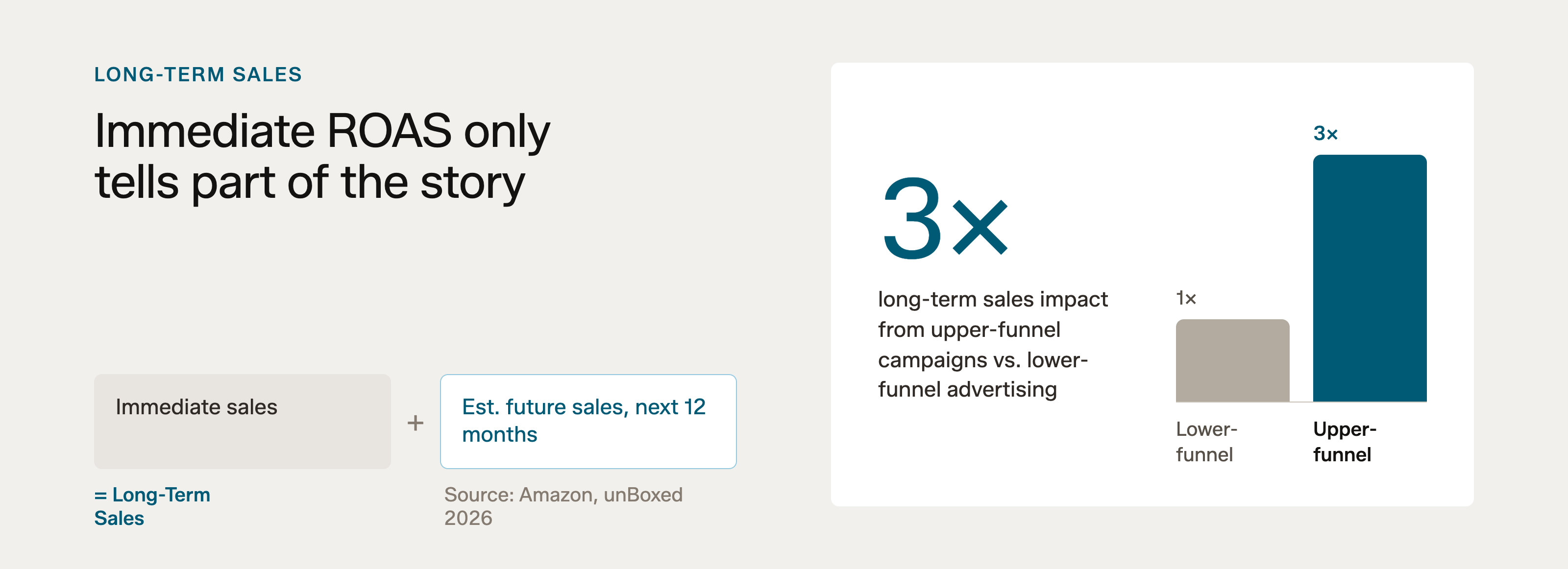
That's why we think Long-Term Sales was one of the most consequential announcements of the week. Long-Term Sales combines immediate sales with estimated future sales from shopping events over the following 12 months. Amazon also shared that upper-funnel campaigns can drive three times the long-term sales impact of lower-funnel advertising.
For years, upper-funnel investment on Amazon has been judged by the same yardstick as Sponsored Products: immediate, ad-attributed revenue. That yardstick systematically undervalues awareness and consideration media, and it pushes budgets toward the bottom of the funnel by default.
Long-Term Sales gives brands a way to tell a fuller story. Our view:
- Add Long-Term Sales to your reporting now, alongside ROAS, so you build a baseline before budget decisions depend on it.
- Revisit how upper-funnel success is defined. If Amazon is optimizing across the funnel, judging results on immediate revenue alone leaves much of the impact off the scorecard.
- Pressure-test the estimate. Long-Term Sales includes modeled future sales, so pair it with your own repeat-purchase and lifetime value data to see how well it holds up for your category.
3. Shopping is becoming a conversation
AI isn't only changing how marketers run Amazon advertising. It's changing how shoppers use Amazon itself.
The numbers Amazon shared at unBoxed make the case:
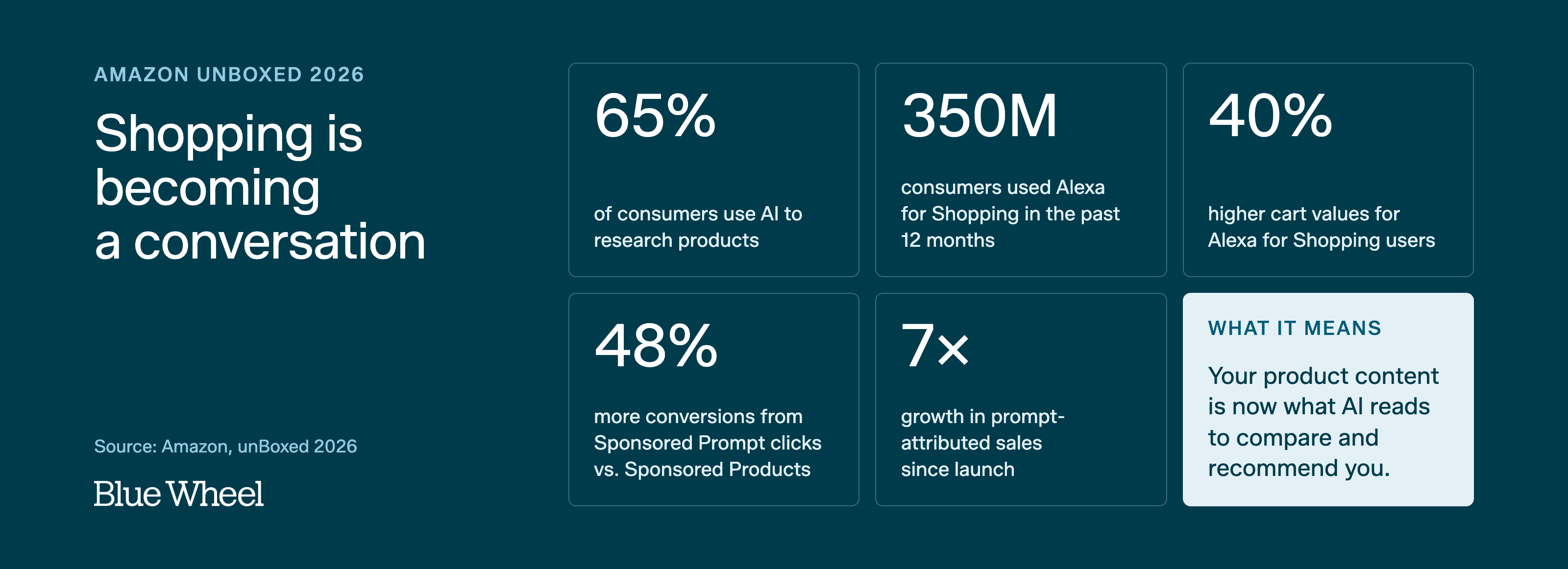
- 65% of consumers are using AI to research products.
- 350 million consumers have used Alexa for Shopping in the past 12 months.
- Shoppers using Alexa for Shopping have 40% higher cart values.
- Sponsored Prompt clicks convert 48% more often than traditional Sponsored Products clicks.
- Prompt-attributed sales have grown 7x since launch.
Amazon is building on that momentum with Branded Conversations, which lets brands supply information that helps Alexa for Shopping answer questions and guide shoppers through discovery.
The implication is straightforward: your product content isn't just written for a shopper scanning a detail page anymore. It's also the raw material AI uses to understand, compare, and recommend your products.
That means going beyond keyword optimization. The better question is whether your content gives Amazon enough context to confidently answer the questions your shoppers are actually asking: who the product is for, how it compares, what problem it solves, and why it's worth the price.
[Image suggestion: Mock-up of a shopper asking Alexa for Shopping a product question, with a Branded Conversations response.]
4. Measurement is moving closer to action
Another major theme at unBoxed was making Amazon's increasingly sophisticated measurement easier to use.
Ads Agent will let advertisers ask natural-language questions across nearly 1,000 metrics, analyze trends, visualize performance, and compare results against peer benchmarks.
Amazon is also expanding how AI works with Amazon Marketing Cloud (AMC). The AMC Expert Tool translates natural-language business questions into the right AMC queries, lowering the technical barrier that has kept many teams from exploring deeper measurement questions quickly.
The real change isn't faster reporting. It's that the distance between question, insight, and action is shrinking.
Instead of spending hours assembling reports before deciding what to do, teams can spend more time where it counts: interpreting results, challenging assumptions, and choosing the right next move.
5. First-party data becomes a competitive edge
The better Amazon's AI gets at making advertising decisions, the more the signals feeding those decisions matter.
Amazon Ads Data Manager is becoming the central hub for bringing first-party data into Amazon's advertising ecosystem. Brands can connect signals like customer lifetime value, product affinity, subscription activity, and off-Amazon conversions, then use them across audiences, optimization, measurement, and AMC analysis.
The value extends well beyond Amazon. First-party data helps brands build a richer picture of who their customers are, how different audiences behave, and which signals point to long-term value. Those insights should inform decisions across retail media, DTC, paid social, streaming, and every other channel in the mix.
Here's the bottom line: access to AI-powered tools won't be a differentiator for long. Most advertisers will have them. The advantage will come from the quality of the data, signals, and strategic direction brands give those systems.
More automation still requires strategy
There's a lot to be excited about coming out of unBoxed 2026. Campaign creation is getting easier. Analytics are becoming conversational. Full-funnel media is more connected. And Amazon is putting sophisticated advertising and measurement capabilities within reach without forcing advertisers to juggle as many separate systems.
But more automation doesn't mean less strategy.
Brands still need to define the objectives, signals, budgets, and guardrails that guide how these tools are put to work. If anything, those decisions matter more when AI can act on them faster and across more of the customer journey.
The marketer's role isn't disappearing. It's moving upstream: from pulling every individual lever to deciding which levers should be pulled, what success looks like, and where human judgment needs to stay in the loop.
That's the shift we'll be watching, and helping our partners navigate, as these capabilities roll out.
Ready to put unBoxed 2026 to work?
Amazon's new tools are only as strong as the strategy behind them. Blue Wheel helps brands set the right objectives, connect the right first-party signals, and measure what actually drives growth across Amazon and the broader retail media landscape.
Whether you're evaluating Ads Agent, building a case for upper-funnel investment with Long-Term Sales, or getting your product content ready for conversational shopping, our team can help you move first. Talk to Blue Wheel's Amazon team →
Auburn Muniz
Auburn Muñiz is the Senior Director of Marketing at Blue Wheel, where she leads the agency's growth marketing strategy and thought leadership initiatives. With more than 12 years of experience driving growth across ecommerce, SaaS, and fintech, she specializes in translating emerging commerce trends, including AI, search, marketplaces, retail media, and creator marketing, into practical strategies that help commerce brands grow.