
As Google integrates AI Overviews, AI Mode, conversational follow-ups, and increasingly automated advertising into the search experience, consumers have more ways to research products, compare options, and narrow their decisions without following the traditional search journey. For eCommerce brands, that changes the role paid search plays.
The question is no longer simply, "How do we rank or bid for this keyword?" Brands now need to ask, "How do we make sure our products are understood, surfaced, and considered when AI helps determine what a shopper sees next?"
This doesn't make traditional paid search less important. It makes the broader ecosystem surrounding it more important. AI isn't killing search, but instead, it is expanding what search is and compressing the path from question to decision.
Google Search Is Moving From Keywords Toward Conversations
Traditional search behavior was built around relatively concise queries.
A consumer might search: "best shampoo for dry hair"
An AI-powered search can be much more specific: "What's the best shampoo for dry, color-treated hair that won't weigh down fine hair?"
That distinction matters.
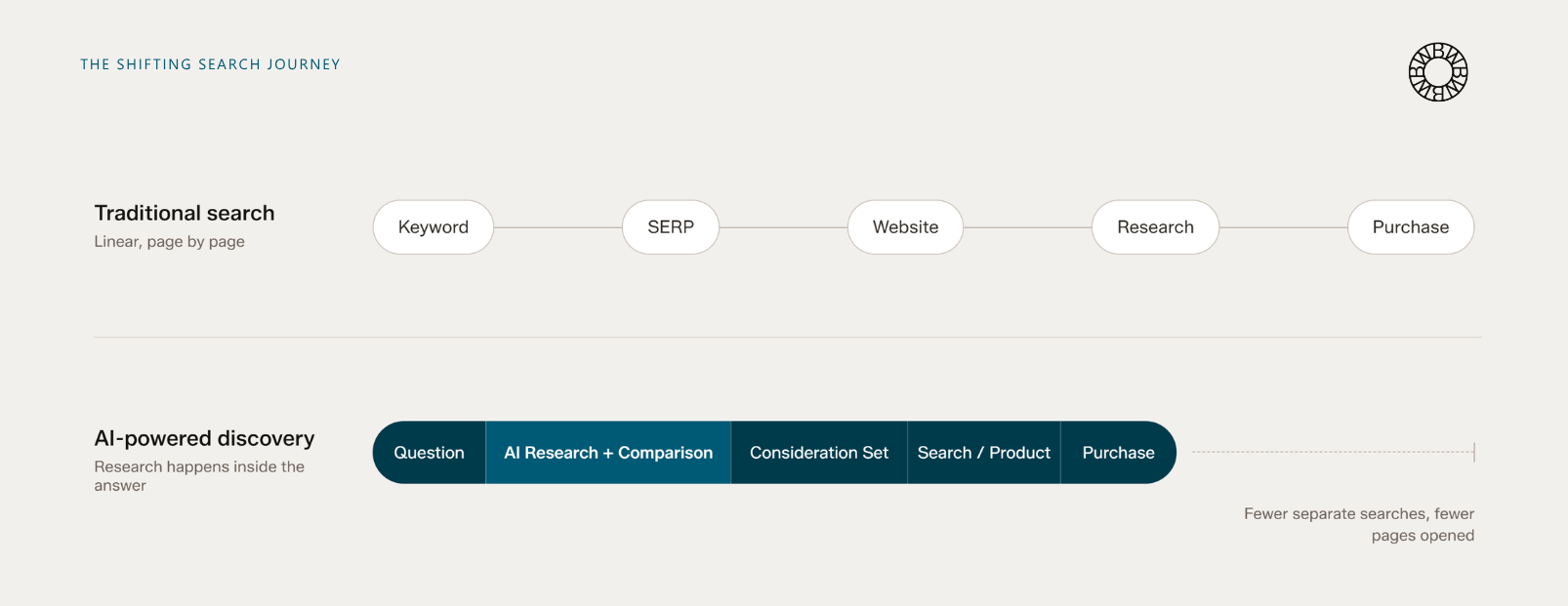
With AI Overviews and AI Mode, Google can synthesize information across sources, respond to more nuanced questions, and help consumers continue exploring through follow-up queries. Instead of conducting several separate searches and opening multiple pages, a shopper can increasingly use Google to move through more of that research process within a single experience.
For paid search marketers, this means intent is becoming more nuanced than the individual keyword. Google needs to understand not only what someone typed, but what they are trying to accomplish. Its advertising products are evolving in the same direction.
AI Max for Search, for example, can expand beyond an advertiser's existing keywords using broad match and keyword-less technology. Google says the system learns from keywords, creative, and URLs to identify additional relevant searches. It can also customize creative and select landing pages based on the intent behind a query.
The implication isn't that keywords suddenly don't matter. It's that they are becoming one input within a much larger collection of signals.
How Are Google AI Overviews Affecting Paid Search?
When AI Overviews first started occupying more space on the search results page, one of the immediate concerns for marketers was straightforward: If Google answers the question itself, will fewer people click?
For some searches, particularly informational ones, that concern is valid. But the implications for paid search are more nuanced.
A shopper researching a broad topic may get much of the information they need directly from an AI-generated response. But commercial searches don't end simply because AI enters the journey. Consumers still need to evaluate products, compare brands, check prices, and ultimately make a purchase.
In fact, Google has been bringing advertising directly into these AI-powered experiences. Ads can appear in AI Overviews, and Google has also tested ads within AI Mode, allowing advertisers to reach consumers while they ask deeper, more complex questions.
That creates a different role for paid search. Instead of assuming every impression should immediately produce a click, brands need to think about how paid search captures demand at different stages of an increasingly AI-assisted decision journey.
A consumer might encounter a brand while researching a problem, see it included in an AI-powered comparison, search the brand later, and then click a paid search or Shopping ad when they're ready to purchase.
The click still matters. But it may happen much later in the consideration process.
Should Brands Change Their Google Ads Strategy Because of AI Overviews?
Yes, but that doesn't mean abandoning the fundamentals of paid search.
High-intent search remains one of the clearest opportunities to reach consumers who are actively looking for a product or solution. What needs to evolve is how brands think about the role of those campaigns within the broader discovery journey.
One area that deserves particular attention is brand protection. As AI-powered discovery introduces consumers to products earlier in their journey, branded search can become the point where consideration turns into action. Brands need to understand what happens when a shopper moves from researching a category or problem to searching for a specific product or company.
If competitors, retailers, or marketplaces intercept that demand, the brand may lose a shopper it helped move into consideration in the first place.
The same is true for high-intent nonbrand searches. Rather than pulling back from paid search because AI Overviews may reduce clicks in parts of the funnel, advertisers should identify where search is still capturing meaningful intent and protect those moments.
The goal shouldn't be to preserve the old search journey. It should be to understand where paid search creates value within the new one.
Are Keywords Becoming Less Important in Paid Search?
While keywords are becoming less dominant, they’re absolutely not becoming irrelevant.
The direction of Google's advertising products makes the shift clear. AI Max for Search uses search term matching to expand beyond existing keywords, while asset optimization can tailor creative and landing pages to the context of the search. Performance Max similarly combines advertiser inputs with Google's automation to identify additional opportunities across Google's inventory.
Google is increasingly asking advertisers to provide the right signals, assets, destinations, product information, and business objectives, then allowing its systems to determine how those inputs should come together for a particular consumer.
That changes the advertiser's job. Paid search teams still need to understand query behavior, search intent, campaign structure, negative keywords, budgets, bidding, and performance. But they also need to pay much closer attention to the quality of everything Google's AI is using to make decisions.
Landing pages matter.
Creative matters.
Product information matters.
Brand controls matter.
Conversion data matters.
And for eCommerce advertisers in particular, product feeds matter.
More automation doesn't mean less strategy. It means the quality of the strategy and the inputs guiding that automation become even more important.
Your Product Feed Is Becoming Part of Your Search Strategy
For eCommerce brands, one of the biggest implications of AI-powered search may be happening behind the scenes.
If Google is trying to answer a highly specific product question, it needs enough information to understand which products actually meet the consumer's criteria.
Consider a shopper searching: "What's a lightweight moisturizer under $50 for sensitive skin that works well under makeup?"
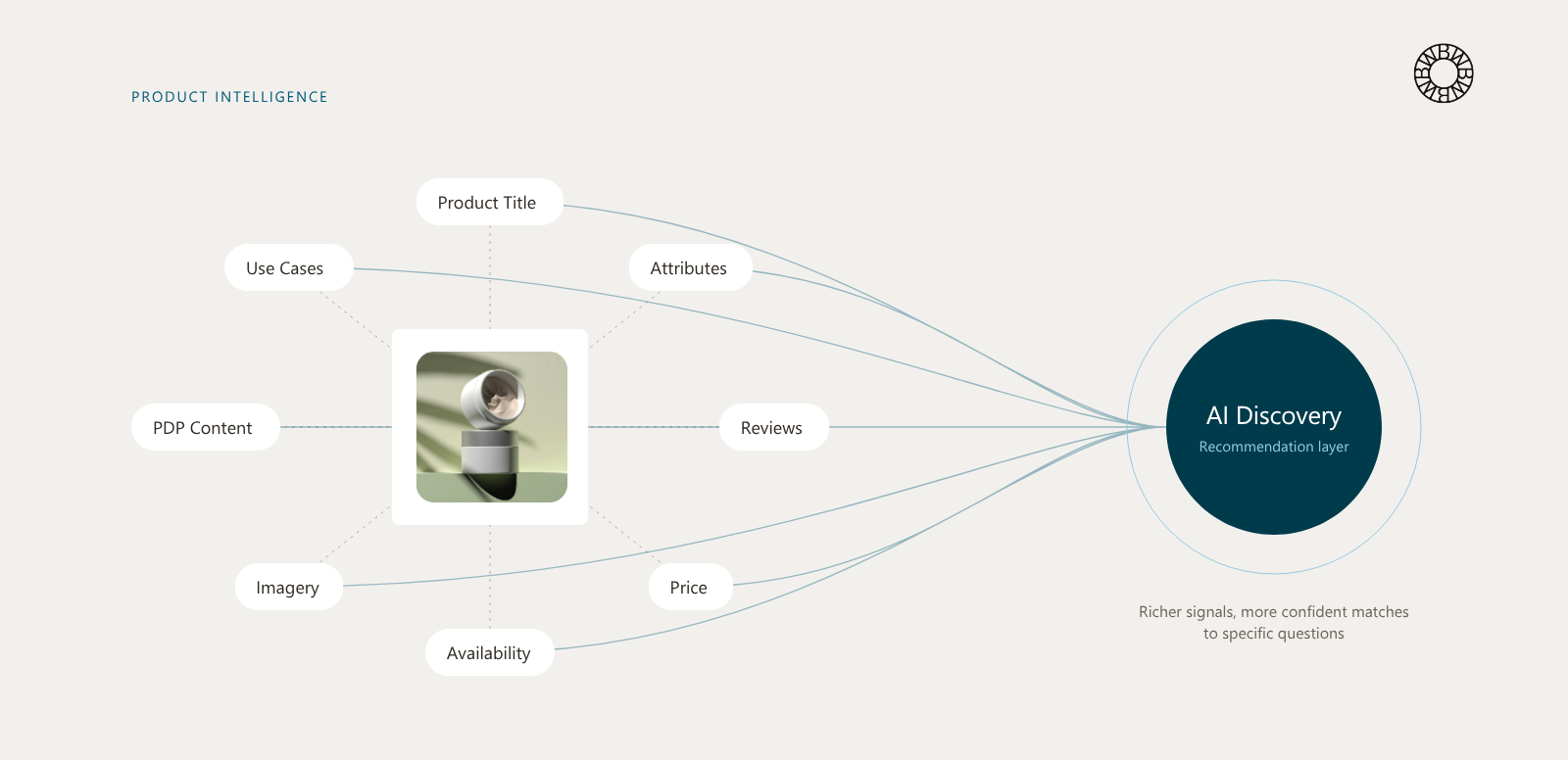
Simply knowing that a product is a "face moisturizer" isn't enough. Google needs signals that help it understand price, skin type, benefits, ingredients, use cases, availability, reviews, imagery, and other product attributes.
This makes product intelligence increasingly important to paid search strategy. Product titles, categories, attributes, descriptions, imagery, pricing, availability, variants, reviews, and landing-page information all contribute to how clearly platforms can understand what a product is and when it may be relevant.
Google's own advertising products are already moving in this direction. AI-powered Shopping features can use Merchant Center feed information to dynamically make product titles more relevant to complex searches and help Shopping campaigns participate in newer AI-driven surfaces.
For brands, the takeaway is simple: Your product feed isn't just an operational requirement. It's a discovery asset. A richer, cleaner, and more consistent product data foundation gives platforms more context to work with as search becomes increasingly conversational.
Paid Search Can't Operate in Isolation Anymore
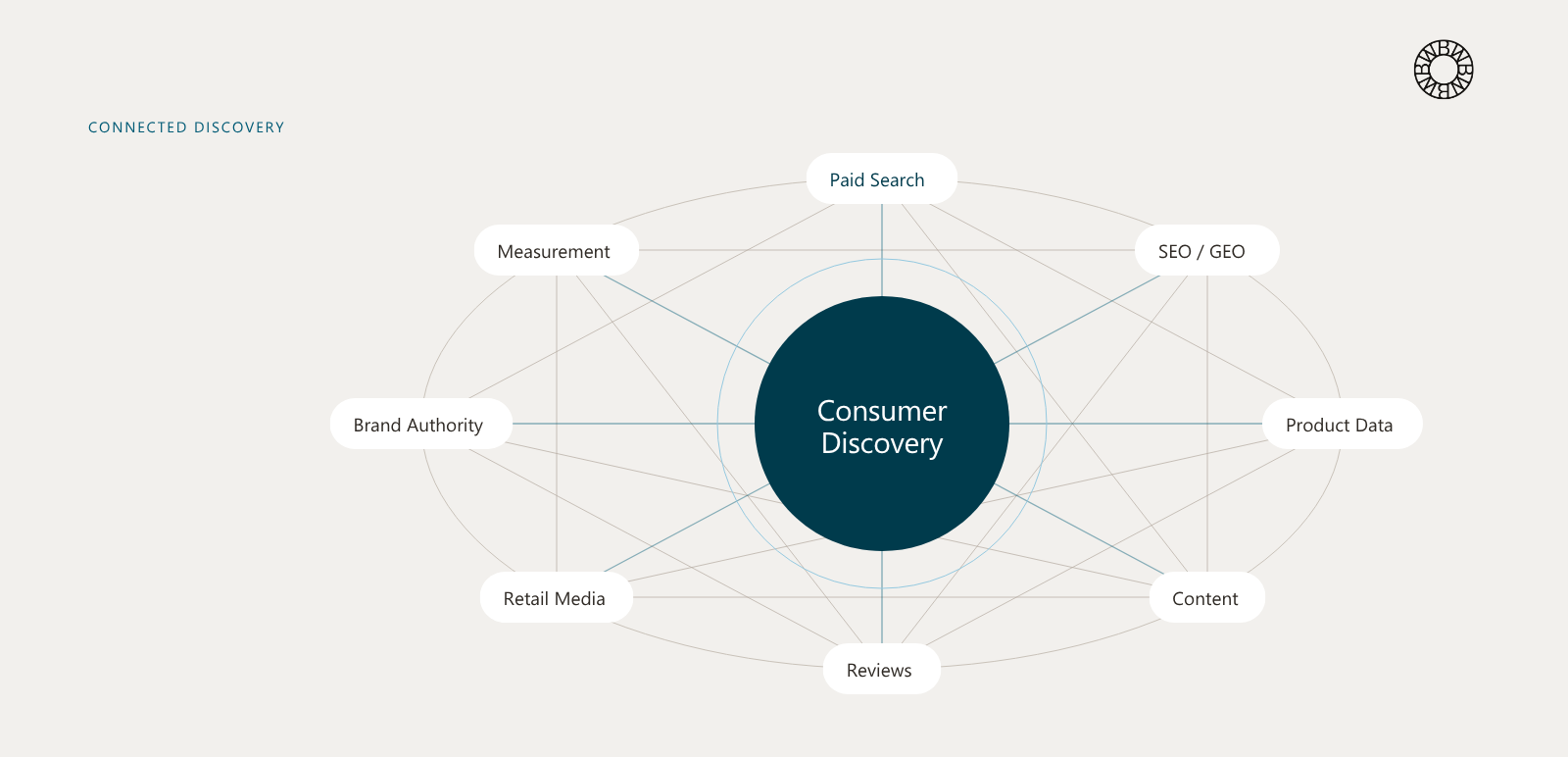
This is where the impact of AI search extends beyond the paid media team. Historically, brands could operate paid search, SEO, content, product feeds, retail media, and marketplace strategy as relatively distinct disciplines.
Consumers don't experience brands that way, and neither do AI-powered discovery systems. When someone asks, "What's the best moisturizer for sensitive skin under $50?" the answer can be influenced by a much broader digital footprint than an individual keyword or ad. Ask yourself these questions:
- Can Google clearly understand the product?
- Does the product page answer the consumer's likely questions?
- Is the product information consistent across the brand's website and retail partners?
- Do reviews reinforce the claims being made?
- Does the brand have authoritative content around the problem the consumer is trying to solve?
- Do other credible sources reinforce what the brand is known for?
- Is the product available and competitively priced?
Paid search is only one piece of that ecosystem. SEO and generative engine optimization (GEO), content strategy, Merchant Center feeds, reviews, retail presence, brand authority, and paid media increasingly need to reinforce one another.
That is why brands shouldn't build an isolated "AI search strategy”, but they need a discovery strategy.
What Happens to Measurement When the Click Isn't the Beginning?
For years, paid search measurement has centered around a relatively familiar sequence:
Impression → Click → Website Visit → Conversion
AI-powered product discovery makes that path harder to follow.
A consumer might ask an AI-powered search experience for recommendations, encounter a brand during a comparison, conduct another search days later, click a branded ad, and ultimately convert.
Which interaction deserves credit?
Last-click reporting might attribute the purchase to paid search. But that doesn't tell us how the brand entered the consideration set in the first place. Conversely, AI-powered discovery may influence a purchase without ever generating a referral to the brand's website.
Measurement therefore needs to expand alongside search behavior.
Brands should still monitor paid search fundamentals such as conversions, CPA, ROAS, search impression share, and query performance. But those metrics should increasingly be evaluated alongside:
- Branded search demand
- New customer and new-to-brand acquisition
- Assisted conversions
- AI referral traffic
- Organic and paid product visibility
- Product-level search trends
- Cross-channel customer journeys
- Incrementality
- AI search visibility
The good news is that measurement is beginning to catch up. Google now provides dedicated Generative AI performance reporting in Search Console, allowing site owners to see impressions within generative AI features such as AI Overviews and AI Mode, including which pages appeared and how visibility changes over time.
That doesn't solve attribution. But it gives brands a new baseline for understanding whether they are being surfaced within Google's AI-powered discovery experiences. As these tools evolve, the goal should be to connect visibility, demand, traffic, and conversion rather than evaluating each channel in isolation.
How Should eCommerce Brands Prepare for AI-Powered Search?
Brands don't need to throw out their existing search strategy and start over. They need to strengthen the signals that already make their products discoverable and compelling while expanding how they think about visibility.
At Blue Wheel, we recommend evaluating AI search readiness across four areas:
1. Discoverability
Can search engines and AI-powered platforms easily find, crawl, and interpret your brand, products, and content?
Technical SEO fundamentals still matter. Google has explicitly stated that there are no special technical requirements for appearing in AI Overviews or AI Mode beyond the foundational requirements and best practices used for Google Search.
AI visibility isn't a replacement for SEO. It builds on it.
2. Product Intelligence
Are your product feeds, PDPs, attributes, descriptions, imagery, reviews, pricing, and availability detailed enough for AI systems to understand what your products are, who they are for, and when they should be considered?
The more specific the consumer's question becomes, the more important that product context becomes.
3. Authority and Relevance
Does your broader digital footprint consistently reinforce what your brand is known for?
Content shouldn't exist simply to target another keyword. It should answer real consumer questions, explain use cases, establish expertise, support comparisons, and make product differentiation clear.
Reviews, retailer listings, brand content, media coverage, creator content, and other third-party signals can all contribute to the broader context consumers encounter while researching a product.
4. Measurement
Are you measuring visibility beyond rankings and last-click revenue?
Establish benchmarks for AI visibility, branded demand, assisted conversion, product discovery, AI referrals, and other indicators now. Measurement capabilities will continue to evolve, but brands need a baseline if they want to understand how consumer behavior is changing.
Five Paid Search Actions Brands Should Take Now
The evolution of search doesn't require brands to chase every new AI feature. It requires them to protect what works while preparing for how discovery is changing.
1. Audit real consumer questions, not just keywords.
Look beyond your keyword report. Identify the questions shoppers ask when comparing products, solving problems, or narrowing options. Then test how your brand and hero products appear for those questions across Google AI experiences.
2. Protect high-intent and branded demand.
Understand where AI-assisted discovery transitions into high-intent search. Make sure your brand remains visible when consumers move from research into consideration and purchase.
3. Strengthen your product data.
Audit Merchant Center feeds, product attributes, PDP content, pricing, imagery, availability, and reviews. Give Google's systems enough context to accurately understand what your products offer and who they're relevant for.
4. Connect paid search with SEO, GEO, content, and commerce media.
Paid search shouldn't have one definition of your product while your website, Amazon presence, product feed, and content tell four others. Build consistency across the discovery ecosystem.
5. Expand measurement beyond last-click ROAS.
Track the indicators that show how demand is developing before the final click. Branded search, AI visibility, assisted conversion, new customer acquisition, and cross-channel behavior can help reveal changes that traditional paid search reporting misses.
The Future of Paid Search Is Bigger Than Paid Search
AI Overviews and AI Mode aren't signals that brands should invest less in search, but instead they are evidence that the definition of search is expanding.
Consumers may start with a keyword, a conversational question, an image, a product comparison, or eventually an AI agent acting on their behalf. The interface may continue changing, but the underlying challenge for brands remains remarkably consistent:
Be easy to find. Be easy to understand. Give consumers a compelling reason to choose you. Paid search will continue to play an important role in that equation. But winning the next era of search will require brands to connect paid media with product intelligence, content, SEO, GEO, retail presence, and measurement.
The brands that succeed won't be the ones that correctly predict which search interface wins. They'll be the ones that build a discovery ecosystem strong enough to show up wherever the consumer starts.

Lauren Palmisano
Lauren Palmisano is the Marketing Manager at Blue Wheel, where she manages all aspects of the company’s content marketing strategy. From overseeing the content calendar to managing blog and case study creation, website maintenance, and running Blue Wheel’s LinkedIn page, Lauren plays a pivotal role in driving the brand’s digital presence. With a career that started in eCommerce event management before transitioning into eCommerce marketing, Lauren brings a well-rounded approach to delivering impactful content and experiences that resonates with audiences.