
Shopping agents have moved past making recommendations. They browse, compare, and check out. That raises a question the industry has mostly been able to ignore: when an agent moves through a retailer's site for you, who is actually doing the shopping?
While a federal appeals court said the shopper, the Ninth Circuit Court of Appeals vacated a preliminary injunction against Perplexity that blocked the Comet browser from shopping on Amazon. This means that Amazon still could win the court case.
The case was Amazon against Perplexity, and the ruling is narrower than the headlines suggest. But the reasoning behind it tells you something useful about where agentic commerce is heading.
What happened
Amazon went after Perplexity in November 2025, demanding it stop letting its Comet browser shop on Amazon. Amazon's argument was that Perplexity's shopping agent was reaching into customers' accounts without permission. A lower court agreed and blocked the feature in March 2026.
On August 4, the appeals court overturned that block. Comet's shopping agent can buy on Amazon on a shopper's behalf while the case continues in the lower court.
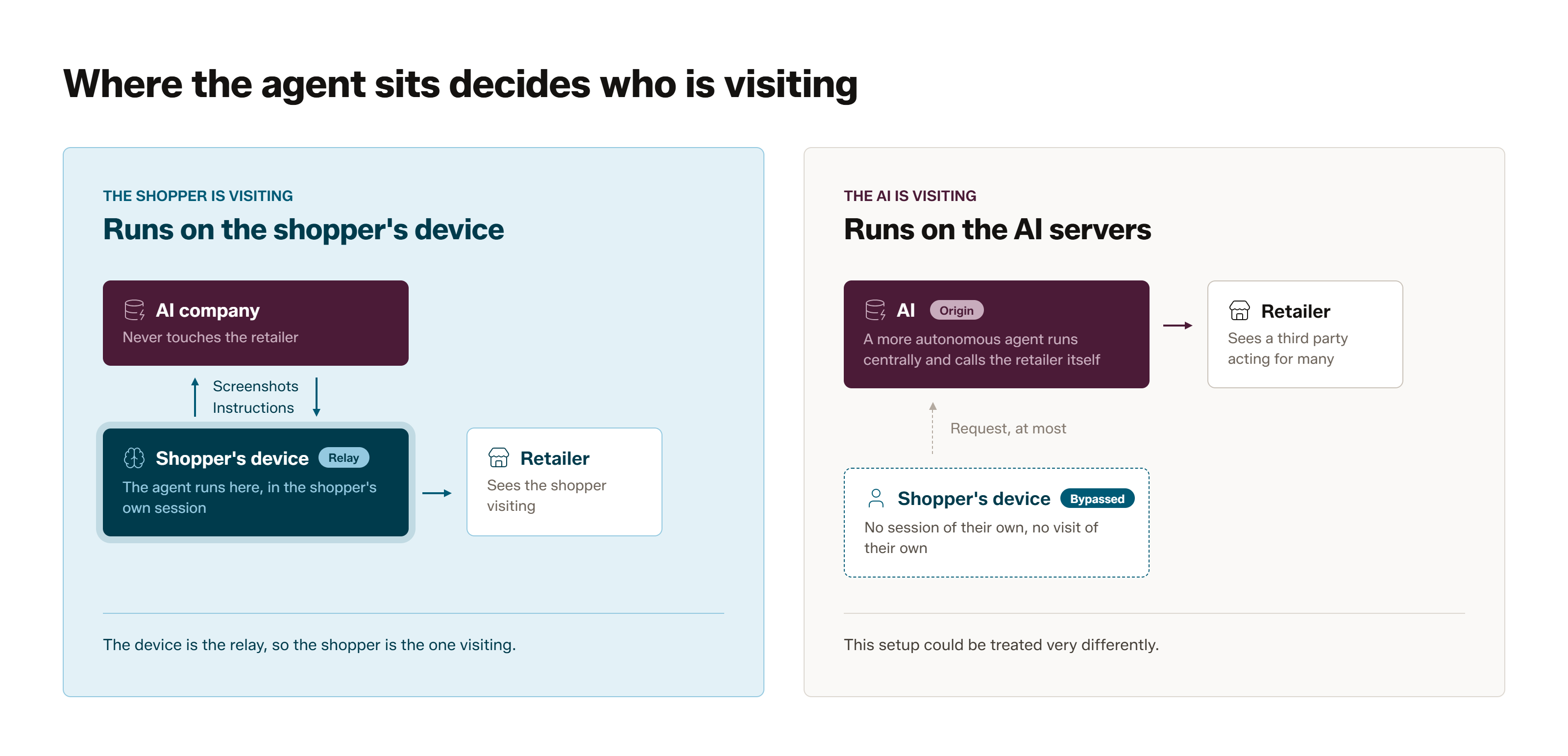
What decided the case was not what the agent can do, but the route its data takes. Perplexity's agent works by taking screenshots of the browser running on the shopper's own computer, sending those to Perplexity, and getting back instructions on what to click. Perplexity's servers never contact Amazon's servers directly. The shopper's machine sits in the middle of every exchange.
Because of that, the court treated the shopper as the one visiting Amazon, with the agent acting as a tool they were using. Amazon has said it disagrees and is weighing its next move.
What the ruling does not do
Three things worth understanding here:
- It is not a final decision. The case is still live and heading back to the lower court.
- It is not permission to build any agent you want. The court was clear that a more autonomous agent, or one connecting directly to a retailer's servers, could be treated very differently.
- It does not close off other options for retailers. Terms of service and other avenues remain available to platforms that want to limit agent access.
The takeaway for the category: how an agent is built may matter as much as what it does.
Why this matters beyond the courtroom
Underneath the legal question though is, “Who controls the layer between a shopper and a retailer?”
Right now it’s the platform that does. Amazon decides what ranks, where sponsored placements sit, and what a shopper sees on the way to checkout. Walmart, Target, and TikTok Shop each control their own version of the same thing. That control is the product.
Agents slide something in between, almost acting as a personal concierge service. Instead of searching, scrolling past sponsored results, and opening five product pages, a shopper asks the assistant, find me the best marathon training shoes under $150 and buy the one that fits. A real share of that journey stops happening inside the retailer's interface.
Retailers are not waiting to find out how the courts settle this. In May 2026, Amazon folded Rufus into Alexa for Shopping, pulling product research and buying into one assistant across its apps, site, and devices, with the clear aim of keeping AI-assisted shopping on its own turf.
Platforms are now building their own agents to keep their shoppers within their own platform but outside agents are working their way in.
What this changes for your brand
While the interface keeps shifting, your product data is the part that holds still, and it is carrying more weight than it used to.
An agent increasingly sits between the shopper and the product page, researching and shortlisting before anyone sees your listing. That listing is no longer only persuading a person. It is the raw material an agent reasons over.
Which means the fundamentals matter more, not less:
- Titles and attributes are read for fit against a specific request, not matched against a keyword.
- Complete catalog data separates being considered from being invisible. A gap a shopper would forgive, a model reads as absence.
- A+ Content convert shoppers and give machines such as Cosmo and Alexa for Shopping context.
- Reviews, pricing, and availability feed agent decisions the way they never fed keyword ranking.
None of this is necessarily new. But what is new is the cost of getting it wrong – when an agent narrows down to three options before a shopper sees a single product page, weak data does not cost you a conversion. Instead, it costs you the consideration set, and everything downstream including velocity, rank, ad efficiency, margin.
Want to see how your catalog reads to an agent?Let's talk. If you are already a client, reach out to your account team.
This post is for general information and is not legal advice.
Blue Wheel
Blue Wheel connects strategy, data, platforms, and people to help commerce brands grow with greater cohesion and impact.
We help brands build more cohesive commerce experiences across marketplaces, retail media, social commerce, DTC, and retail. With over $2B in client revenue managed, our team helps brands amplify their growth, cohesion, and presence across the entire commerce ecosystem.