
Announced on July 7, 2026, Google’s new Platform Properties expand Search Console beyond traditional websites by allowing site owners and creators — including those who have never owned a website — to understand how their public social content performs in Google Search and Google Discover. Rather than treating social content as activity that lives only within Instagram, TikTok, X, or YouTube, Google is providing new visibility into how that content contributes to long-term discovery.
The update may appear to be another reporting enhancement, but it signals something larger. Creator content is becoming part of the broader search ecosystem, giving brands a new way to evaluate how their investments influence discovery beyond social engagement.
Brands that use these insights to unify creator marketing, organic social, SEO, AI visibility, and commerce strategy will be better positioned to understand what content earns attention, continues answering shopper questions, and contributes to visibility across the customer journey.
What Are Google’s Platform Properties?
Platform Properties allow eligible accounts to measure impressions, clicks, click-through rate, average position, and top-performing posts for supported public profiles on Instagram, TikTok, X, and YouTube — all inside Google Search Console. One important limit: these reports describe how content performs on Google’s surfaces only. Native TikTok views, Instagram likes, and YouTube watch time from in-app feeds are not included.
Traditionally, Search Console focused primarily on owned websites. Platform Properties extend that measurement to public creator content, helping identify which topics, formats, captions, and content themes generate visibility within Google Search. The shift has been building for a while: Google began indexing public Instagram content from Business and Creator accounts in 2025, and Platform Properties now put measurement behind that visibility.
It is worth separating this from Search Profiles, the public creator profile pages Google launched earlier in 2026. Search Profiles are audience-facing; Platform Properties are private measurement. Together, they create a new feedback loop between social content and search behavior. Unlike social engagement, which is often concentrated in the days immediately after a post is published, search visibility may continue as long as the content remains relevant and continues answering consumer questions.
This Is More Than a Reporting Update
On the surface, Platform Properties may look like another analytics feature. We believe the more important story is what Google has chosen to measure.
By bringing public creator content into Search Console, Google is acknowledging that discovery no longer begins and ends on traditional websites. Consumers move between search engines, social platforms, marketplaces, retail sites, creator content, and AI tools as they research products and make decisions.
Back in 2022, Google’s own internal research found that almost 40% of people ages 18 to 24 turned to TikTok or Instagram rather than Google Search or Maps when looking for a place to eat. The finding was specific to local discovery, but it demonstrated an important behavioral shift: younger consumers increasingly begin searches in visual, creator-driven environments.
Platform Properties are another indication that Google is adapting to that shift by bringing social and creator content more directly into its search measurement ecosystem. Access is rolling out gradually, so the option may not appear in every Search Console account yet.
Why This Matters for Brands
For years, brands have evaluated creator marketing through metrics such as reach, engagement, views, traffic, and attributed conversions.
Platform Properties introduce another layer of value: sustained discovery.
Brands can begin identifying which creator content continues appearing in Google Search after a campaign’s initial engagement window has passed. Educational videos, product reviews, comparisons, tutorials, demonstrations, and problem-solving content may continue answering shopper questions weeks or months after publication.
That helps close a long-standing measurement gap. Creator content has always had the potential to influence organic discovery, but brands have had limited visibility into that impact.
Platform Properties make it possible to begin asking a more strategic question: Did this creator partnership generate a moment of engagement, or did it create an enduring discovery asset?
Visibility Is Becoming More Important Than the Click
This update also arrives as the definition of search performance is changing.
SparkToro’s analysis of Similarweb clickstream data found that 68% of U.S. Google searches ended without a click during the first four months of 2026. Fewer than one-third resulted in a visit to the open web, a Google-owned property, or a paid result.
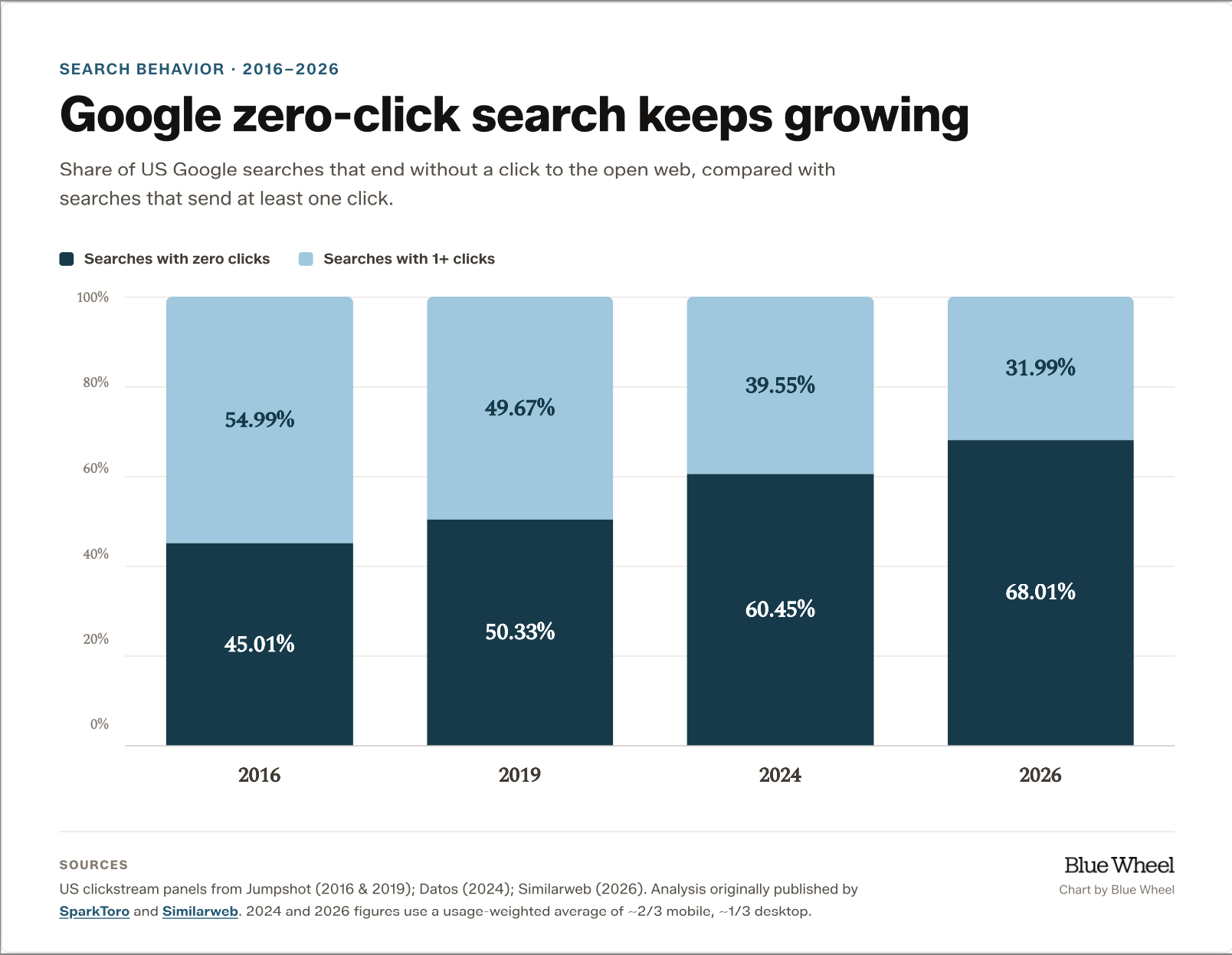
That does not mean search is becoming less valuable. It means brands need to think beyond website traffic as the only measure of success.
Consumers may encounter a brand, product, creator recommendation, review, or answer directly within the search experience without immediately visiting the brand’s website. As AI-generated answers and richer search results become more prominent, the ability to appear, influence consideration, and remain recognizable becomes increasingly important.
For brands, visibility itself is becoming a strategic outcome.
A Different Discovery Journey Requires a Different Strategy
The biggest mistake brands can make is continuing to manage creator marketing, search, retail media, and owned commerce as disconnected programs.
Consumers do not experience them separately.
A shopper may first discover a product through a creator on Instagram, search for reviews on Google, compare options on Amazon, ask an AI assistant for a recommendation, and complete the purchase through a retailer.
Every touchpoint contributes to how that shopper understands the product and whether the brand earns consideration.
The scale of social media reinforces why this matters. DataReportal identified 5.79 billion active social media user identities worldwide as of April 2026, representing close to 70% of the global population. The source notes that these identities may not always represent unique individuals, but the number still demonstrates the enormous role social platforms play in modern discovery.
Creator content can no longer be treated as a temporary social activation. It increasingly contributes to a broader network of signals that shoppers, search engines, marketplaces, and AI platforms use to understand brands and products.
Creator Content Is Becoming a Long-Term Commerce Asset
Historically, creator campaigns were often built around a launch date, promotional window, or immediate engagement goal. Once the campaign concluded, the content’s value became difficult to quantify.
Platform Properties create an opportunity to evaluate creator content differently.
A strong piece of creator content may continue to:
Answer common shopper questions
Demonstrate how a product is used
Address objections and purchase barriers
Compare options within a category
Appear for relevant Google searches
Influence future website, product-page, and content strategies
This means the most valuable creator content may not always be the post that generates the largest initial reach. It may be the content that continues appearing when consumers actively search for information.
The Bigger Opportunity: Search-Informed Creator Strategy
Most of the conversation around Platform Properties will focus on reporting. We think the larger opportunity is optimization.
Search performance can help brands understand which creator topics, questions, formats, captions, and educational angles continue generating discovery. Those insights can then inform future creator briefs and broader content planning.
Creator briefs should not become rigid SEO documents. The creator’s voice, audience relationship, and authenticity still matter.
The opportunity is to combine that authenticity with a clearer understanding of consumer intent.
What We Recommend for Brands
Incorporate search performance into creator reporting
Add search impressions, clicks, queries, and longer-term visibility to creator reporting when the data is available. These metrics should complement, not replace, traditional measures such as reach, engagement, traffic, and conversions.
Use search insights to strengthen creator briefs
Look for recurring questions, high-interest topics, and natural-language searches that creators can address authentically through demonstrations, reviews, tutorials, and educational content.
Identify content with lasting value
Evaluate which posts continue earning visibility after their initial social engagement period. This can help brands recognize creators and content formats that contribute to sustained discovery.
Connect creator insights to the broader organization
Search-performing creator content can inform product-page copy, frequently asked questions, website resources, retail content, paid creative, and future campaign development.
Unify measurement across the customer journey
Creator marketing should not be evaluated in isolation. Connect creator performance with organic search, social engagement, marketplace activity, site behavior, and downstream business outcomes to develop a more complete picture of its value.
The Growth of Creator Marketing Raises the Stakes
Influencer Marketing Hub projected the influencer marketing industry would reach $32.55 billion in 2025, up from $24 billion in 2024.
As more investment flows into creator programs, brands will face greater pressure to demonstrate value beyond surface-level metrics.
Platform Properties will not solve creator attribution on their own. However, they provide an additional signal that can help brands understand whether creator investments contribute to ongoing discovery and how that content supports the broader commerce journey.
Final Takeaway
Google’s Platform Properties update isn’t really about adding another reporting dashboard. It’s about recognizing that creator content now plays a measurable role across the entire discovery journey.
The brands that win won’t be the ones that simply add Search impressions to their creator reports. They’ll be the ones that break down the walls between creator marketing, organic social, SEO, AI visibility, marketplaces, retail media, and owned commerce.
By building creator content around real shopper questions and using performance data across channels to guide what comes next, brands can create a more unified presence that is easier for consumers, search engines, marketplaces, and AI platforms to discover, understand, and recommend.
If you are working to connect creator marketing with search, retail media, and marketplace performance, Blue Wheel’s social commerce team can help you build the measurement framework to support it. Get in touch to start the conversation.
Auburn Muniz
Auburn Muñiz is the Senior Director of Marketing at Blue Wheel, where she leads the agency's growth marketing strategy and thought leadership initiatives. With more than 12 years of experience driving growth across ecommerce, SaaS, and fintech, she specializes in translating emerging commerce trends, including AI, search, marketplaces, retail media, and creator marketing, into practical strategies that help commerce brands grow.