
Meta CPMs are getting more expensive, and brands are asking a reasonable question: Why are we paying more to reach the same audience?
There's no single explanation. Seasonal competition can put pressure on auction prices, and so can more advertisers competing for the same impressions. And across Meta, the advertising system itself continues to evolve as AI plays a larger role in deciding which ads are eligible and relevant for each person.
That makes rising CPMs important, but CPM alone is not enough to diagnose paid social performance. The more useful question for brands is, “how much business value are we generating from every impression we buy?”
That distinction matters because Meta's strategy is not centered on making impressions cheaper. Its advertising technology is increasingly designed to improve matching, prediction, and personalization so the platform can identify the ad most likely to produce value for a particular person.
For brands, that changes where the opportunity lies. Paid social efficiency now depends on the quality of the entire system surrounding media delivery: creative, conversion signals, campaign structure, offers, landing pages, existing demand, measurement, and ultimately the economics of the customer being acquired.
Why Are Meta CPMs Rising?
CPM, or cost per thousand impressions, reflects what an advertiser ends up paying for 1,000 impressions in Meta's auction. And because that inventory is auction-based, CPMs naturally fluctuate as advertiser demand, available inventory, audiences, seasonality, placements, and other factors change. Higher competition often means higher prices. Meta's Q3 2026 earnings reflect that pressure, as it shows the average price per ad rose 14% year over year, even as ad impressions grew 10%.
At the same time, Meta has been fundamentally changing how ads move through its recommendation system.
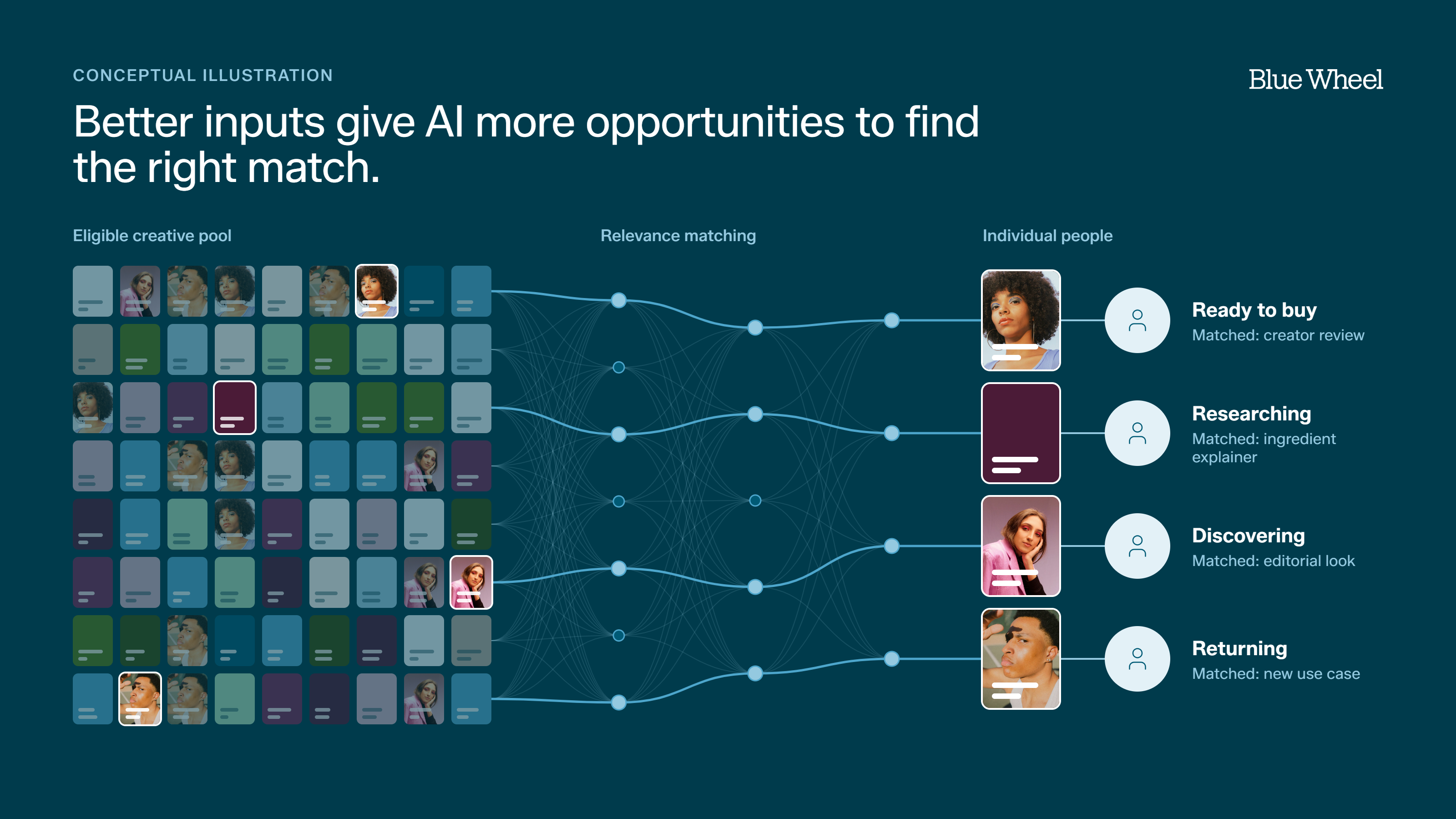
One of the most important developments is Andromeda, Meta's AI-powered ads retrieval engine. Retrieval is the first stage of Meta's ad recommendation process, where the system identifies a smaller group of relevant ads from an enormous pool of eligible candidates before more sophisticated ranking models determine which ads should ultimately appear.
Meta's latest generation of Andromeda scores every eligible ad at more than one billion ads per second, which Meta says is a 100x lift over its 2024 system, and uses richer signals, including sequential engagement and LLM-derived semantic features, to determine relevance. That does not mean Andromeda itself is responsible for higher CPMs, as there is not enough evidence to make that connection directly.
What it does mean is that Meta is becoming increasingly sophisticated at determining which ads should compete for an impression, which raises the stakes on relevance.
Meta Isn't Necessarily Trying to Make Impressions Cheaper
When CPMs increase, the natural instinct is to focus on getting them back down. Sometimes there are legitimate opportunities to reduce media costs, but treating lower CPM as the primary objective can lead brands toward the wrong optimization decisions.
Meta's broader direction suggests a different approach. The platform is investing heavily in AI systems that can evaluate more ads, process more signals, improve prediction accuracy, and identify stronger matches between users and advertisers. For advertisers, the goal should therefore extend beyond buying cheaper impressions. It should be creating more value from the impressions they already buy.
Across the accounts Blue Wheel manages, performance pressure can show up in several places: lower ROAS, higher CPA, weaker conversion rates, rising traffic costs, or a combination of factors. CPM may contribute to those outcomes, but it rarely tells the entire story.
The economics of paid social are shaped by what happens throughout the customer journey. Creative relevance and engagement influence whether an impression earns attention and drives qualified traffic. From there, the strength of the offer, landing page experience, and onsite conversion determine whether that traffic turns into revenue. Customer quality and the value created after acquisition ultimately determine whether that investment produces profitable growth.
This is why the strongest Meta strategies evaluate performance as a connected system rather than optimizing any one metric in isolation.
How Should Brands Respond to Rising Meta CPMs?
There are five areas we believe brands should prioritize as Meta's advertising ecosystem becomes more automated and auction pressure continues to evolve.
1. Build Meaningful Creative Diversity
Creative diversity has become one of the most important inputs brands can provide Meta. But more ads does not automatically mean more creative diversity.
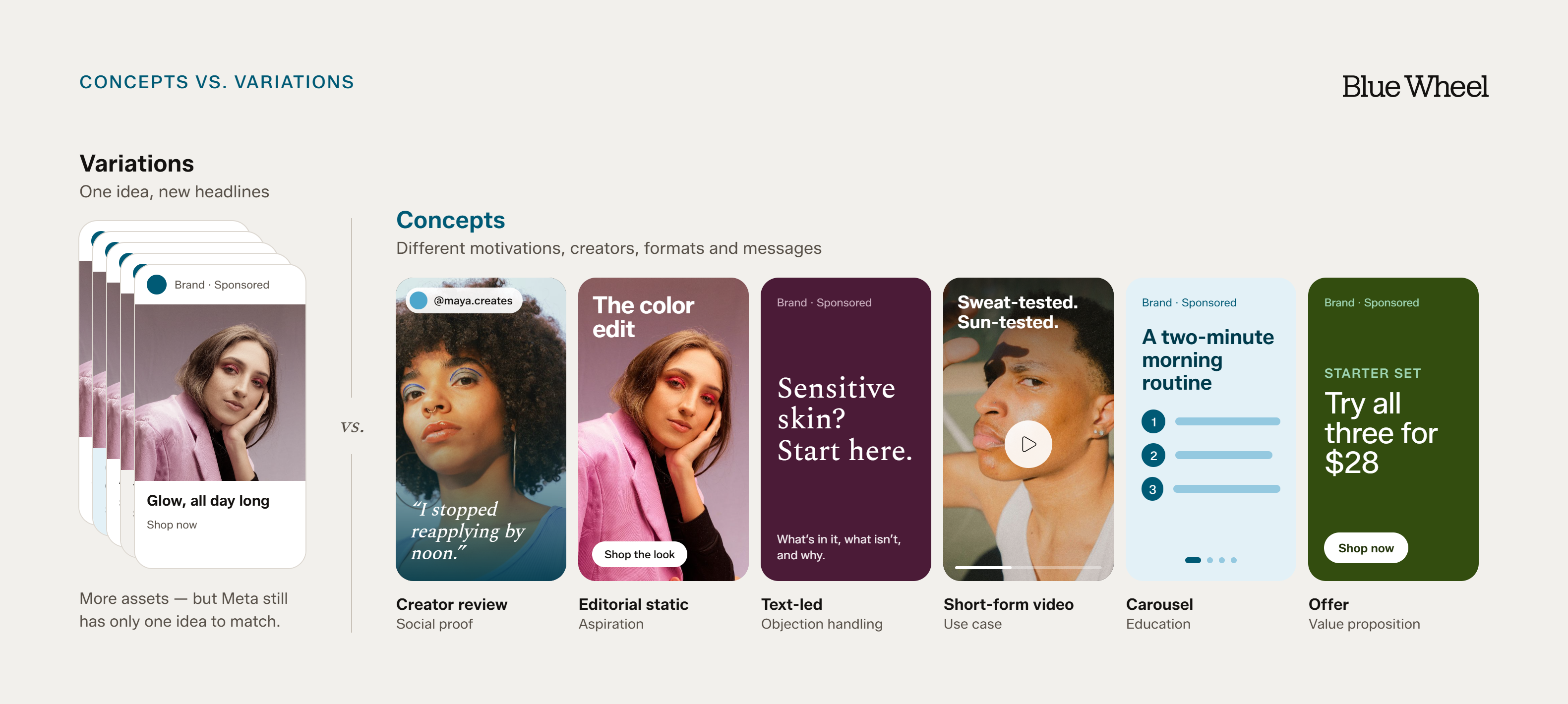
Producing ten versions of the same concept with a different headline, background color, or opening frame may increase the number of assets in an account without meaningfully expanding the ideas Meta has available to match with different consumers.
Brands should prioritize materially different concepts. That can mean testing different consumer motivations, hooks and value propositions, product benefits, use cases, objections, creators, formats, products, stages of awareness, and audience angles.
This was also one of the strongest themes we heard directly during conversations with Meta's Creative Shop team earlier this year. Creative approaches that performed well historically are not guaranteed to deliver the same results year after year. Consumer attention changes, competition changes, and Meta's delivery technology changes with it.
Brands need a consistent pipeline of genuinely new ideas, combined with enough patience to give promising concepts sufficient delivery to generate a reliable read. The objective is not endless creative volume. It is giving Meta meaningfully different options for different people and different moments.
2. Consolidate Campaign Structure Where It Makes Sense
As Meta becomes more capable of identifying relevant audiences algorithmically, highly fragmented account structures can sometimes restrict the system's ability to learn and allocate delivery.
That does not mean every advertiser should collapse everything into one campaign. Campaign separation can still be important when there are legitimate differences in objectives, products, markets, economics, customer strategies, or measurement requirements.
The better question is whether each layer of complexity is doing useful strategic work. Where objectives and economics are similar, consolidation can reduce redundant learning and give Meta more flexibility to find valuable opportunities.
Broad targeting can also allow creative to carry more of the relevance burden, with Meta determining which concepts resonate with different people.
Blue Wheel's POV: Simplify with purpose. Account structure should create meaningful strategic distinction, not complexity for complexity's sake.
3. Build Demand Upstream
Bottom-of-funnel advertising is extremely effective at capturing existing intent. The challenge is that it cannot create all the demand a growing brand needs. If brands continuously optimize toward the same pool of high-intent consumers, growth eventually becomes constrained by the size and quality of that pool. Upper-funnel investment has a different role: it creates familiarity, consideration, and future demand so more consumers eventually enter the conversion system.
This distinction becomes especially important when brands see BOF ROAS soften. Cutting upper-funnel investment may improve a short-term efficiency metric while weakening the pipeline of future demand that conversion campaigns rely on.
That does not mean awareness campaigns should be treated as a guaranteed way to reduce CPMs. They should be measured against the objective they are designed to achieve and their contribution to downstream performance. The goal is to understand how the entire funnel works together.
4. Diagnose the Full Economics, Not CPM in Isolation
One of the easiest mistakes brands can make is seeing CPM increase and immediately assuming media has become less efficient. CPM only answers one question: What did access to the audience cost?
A stronger diagnosis follows the entire performance chain:
CPM → CTR → CPC → CVR → CPA → ROAS → Customer Value / Profitability
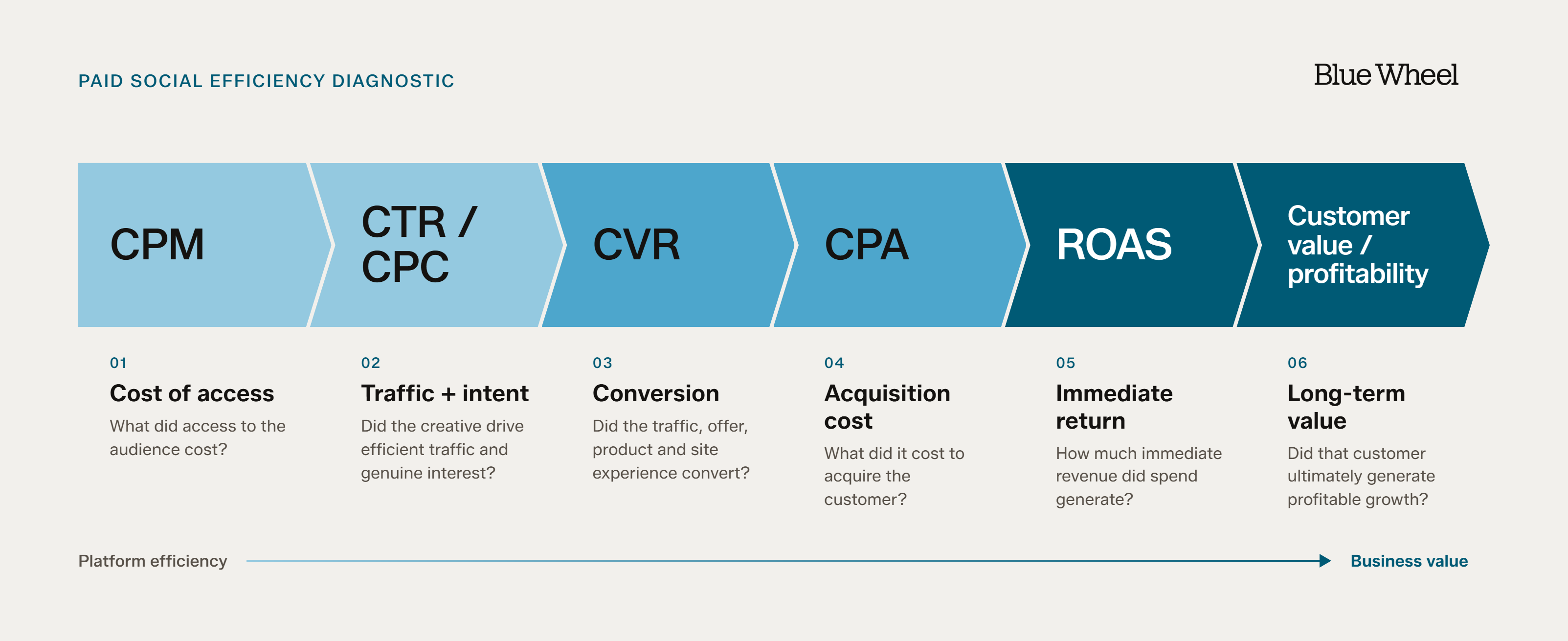
Each metric tells us something different.
- CPM: What did access to the audience cost?
- CTR and CPC: Did the creative drive efficient traffic and signal genuine interest?
- CVR: Did the traffic, offer, product, and site experience convert?
- CPA: What did it cost to generate the conversion or acquire the customer?
- ROAS: How much immediate revenue did that spend generate?
- Customer value and profitability: Did that customer ultimately generate enough economic value to justify the investment?
This is where the conversation becomes much more useful than simply asking whether CPM is "too high."
Imagine CPM rises 20%, but stronger creative improves CTR, a better landing page increases conversion rate, and the resulting customers have a higher repeat-purchase rate. Media became more expensive, but the economics may still have improved.
For brands with meaningful repeat purchasing, LTV can provide important context beyond first-purchase ROAS. Depending on the business model, brands may also need to evaluate incrementality, new-customer ROAS, contribution margin, and profit.
The goal is to understand the actual incremental value media creates across the customer journey, not optimize around a single platform metric.
5. Improve the Inputs Meta Uses to Make Decisions
As targeting and delivery become more automated, the marketer's role is evolving. There may be less value in constantly manipulating audiences and more value in improving the inputs the algorithm uses to make decisions.
That includes:
- Creative: Are we providing genuinely different concepts that speak to different motivations?
- Conversion signals: Is Meta receiving reliable data about the actions that matter to the business?
- Landing pages: Does the post-click experience deliver on the promise made by the ad?
- Offers: Is the proposition strong enough to convert increasingly expensive attention?
- Merchandising: Are the right products being featured for the right consumers and moments?
- Campaign objectives: Are we clearly telling the platform what business outcome we actually want?
- Measurement: Are we evaluating performance against the metrics that represent incremental business value?
Automation makes these decisions more important, not less. The platform can optimize toward the signals it receives. Marketers still have to determine which signals, objectives, experiences, and economics should guide it.
Why Creative Strategy Matters Even More in an AI-Driven Meta
The evolution of Andromeda helps illustrate why creative deserves particular attention.
Meta originally described Andromeda as a system capable of dramatically increasing the capacity of its retrieval models, allowing it to identify relevant ads from an expanding pool of eligible creative. Its latest system goes further, evaluating vastly more eligible ads while incorporating richer user, contextual, and semantic signals.
The implication for marketers is significant. As Meta gets better at matching ads to people, advertisers need to give the system meaningful choices. A larger library of nearly identical assets does not necessarily accomplish that.
A library containing different messages, products, emotional appeals, use cases, creators, formats, and value propositions gives the system a richer set of possibilities. This is why creative strategy is such an important part of media strategy.
The brands positioned to succeed will have systems capable of continuously developing, testing, learning from, and refreshing distinct creative concepts.
Should Brands Change Their Meta Strategy When CPMs Rise?
Not automatically. A rising CPM should trigger diagnosis before reaction.
Before reducing budgets, restructuring campaigns, or retreating toward bottom-of-funnel activity, determine where the efficiency problem is actually entering the system.
If CPM increased but CTR improved, creative may be earning stronger attention. If CTR is healthy but CPC is rising, evaluate auction pressure and placement mix. If traffic remains efficient but CVR falls, the issue may sit with the offer, product mix, landing page, or site experience.
Likewise, if CPA rises but acquired customers deliver higher LTV or contribution margins, first-purchase efficiency alone may not capture the full economics. However, weaker performance across the entire chain may warrant a broader strategic shift.
The point is not to defend higher CPMs. It is to identify what is actually driving the change in performance so brands can solve the right problem.
Protect Stability During High-Stakes Sales Periods
Timing also matters. November and December are high-risk periods for many eCommerce brands, and rising auction costs during peak do not automatically justify rebuilding a Meta account that has otherwise been performing.
During critical revenue windows, brands should prioritize controlled optimization within proven campaigns, creative and offer agility, thoughtful budget pacing, and close monitoring of downstream performance. Larger structural experiments can be sequenced into periods where the business has enough room to evaluate the results properly.
That creates a healthier balance between adaptation and stability. Brands should continue generating hypotheses throughout peak, then carry the strongest testing opportunities into lower-risk periods rather than allowing temporary stability to become permanent inertia.
A New Definition of Meta Efficiency
For years, digital advertising gave marketers enormous control over targeting. AI-driven platforms are gradually shifting some of that control toward algorithmic decision-making.
That does not reduce the importance of marketers. It changes where marketers create value.
The competitive advantage increasingly comes from building the system around the algorithm: differentiated creative, reliable conversion data, strong landing experiences, compelling offers, intentional demand generation, smart campaign architecture, and measurement connected to business economics.
CPMs will continue to move as competition, seasonality, consumer behavior, and Meta's advertising ecosystem evolve. Brands cannot fully control that, but they can influence what happens after they win the impression.
At Blue Wheel, our view is simple: we cannot control the price of the auction, but we can control how much value we create from it. The goal is not simply to get CPMs back down. The goal is to make the economics work even when they do not. Want a second look at your Meta account economics before the end of the year? Reach out to talk to our paid social team.
